
Your Brain on Fear, Dopamine & Social Media | Neuroscientist Sankalp on Mental Health, Meditation & the Age of AI
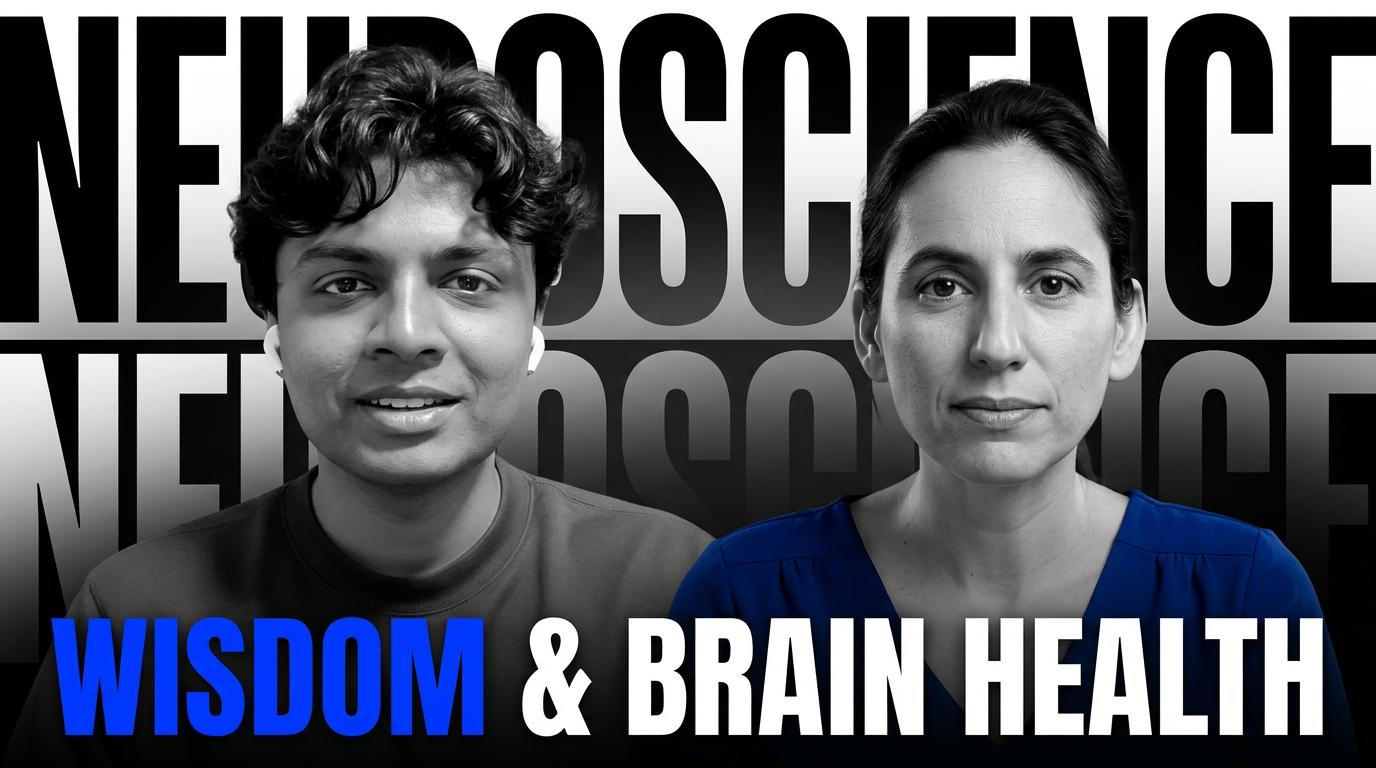
Listen to the entire episode on Spotify, Apple Podcasts, or most major platforms
Your Brain on Fear, Dopamine & Social Media | Neuroscientist Sankalp on Mental Health, Meditation & the Age of AI
What if the mental health crisis, the attention economy, and the rise of AI are all pointing to the same thing — the urgent need to understand your own mind?
In this return conversation, Melanie sits down again with Sankalp, postdoctoral research associate at the University of Oxford's NeuroSCOPE group, where he investigates the relationship between emotions and decision-making, anhedonia (the reduced ability to experience pleasure), depression, and the neural mechanisms behind them using ultra-high-field MRI. He completed his PhD in Experimental Psychology at Oxford, where he explored how social environments shape our tendency toward connection, and how social decisions relate to our mental health. He also has over two decades of meditation practice, including five silent 10-day retreats, which makes him uniquely placed to bridge neuroscience and lived wisdom.
This is a rich, layered conversation that goes well beyond the lab.
What we explore in this episode:
Sankalp opens by reframing the true cost of mental health — not just personal suffering, but an economic burden that rivals a pandemic, recurring every single year. He challenges the popular "chemical imbalance" narrative around depression, explaining why our current psychiatric categories are far looser and more arbitrary than most people realise, and why two people with the same diagnosis can present with completely different symptoms.
From there, the conversation moves to serotonin — one of the least understood neurotransmitters despite its cultural prominence — and what science actually does and doesn't know about its role in mood, gut health, delayed gratification, and environmental tracking.
They go deep on addiction: why it isn't simply about substances, but about unmet human needs being filled through increasingly unhealthy channels — including TikTok, social approval, and the algorithmically engineered "like" button. Sankalp explains precisely when social media shifted from a connection tool to a dopamine trap, and what that means for teenagers in particular.
The discussion turns to fear — how the amygdala evolved to protect us, and what happens when manufactured fear is delivered on command, at scale, through our screens. Then, to the neuroscience of social connection: why humans evolved complex brains specifically to cooperate, why connected people literally get sick less, and why now is the time to reach out more, not less.
Sankalp brings it all together through meditation, wisdom, and the age of AI — arguing that as artificial agents handle more of our workload, clarity of values and contemplative practice become more important than ever, not less.
Guest Bio:
Sankalp is a postdoctoral research associate in the NeuroSCOPE group at the University of Oxford, led by Laurel Morris. His research focuses on the relationship between emotions and decision-making, with a particular focus on anhedonia — the reduced ability to experience pleasure — as a key symptom of depression and its relationship to overall mental health. He uses ultra-high-field MRI to investigate the neural mechanisms behind anhedonia and depression. He completed his PhD in Experimental Psychology at Oxford under Professors Matthew Rushworth and Miriam Klein-Flügge, where he studied how social environments shape our propensity for social affiliation, how social decisions relate to mental health, and what neural mechanisms underpin those decisions. He has practised meditation for over two decades and has completed five silent 10-day retreats.
Episode Overview
What if everything you’ve been told about mental health… isn’t quite accurate?
In this episode, Melanie Suzanne Wilson sits down with neuroscientist Sankalp to explore the deeper realities behind mental health, brain chemistry, addiction, and the rapidly changing world shaped by AI.
From debunking the “chemical imbalance” myth to unpacking dopamine, serotonin, and the hidden drivers of behaviour — this conversation challenges surface-level thinking and invites a more nuanced, human understanding of how our minds actually work.
They also explore the intersection of neuroscience and modern life:
Social media addiction
Fear and decision-making
The importance of human connection
And why clarity, values, and wisdom are becoming essential in the age of AI
This is not just a conversation about the brain.
It’s a conversation about how we live, work, and lead — now and into the future.
Key Topics Covered
Why mental health is as impactful as a global economic crisis
The truth about dopamine, serotonin, and neurotransmitters
Debunking the “chemical imbalance” theory
Why mental health diagnoses are more complex than we think
The risks of self-diagnosis and over-labelling
Meditation as a tool for understanding the mind (not just stress relief)
Addiction, dopamine loops, and unmet human needs
Social media, validation loops, and attention hijacking
Fear, the brain, and how it impacts decision-making
The neuroscience of connection and why relationships improve health
Productivity, rest, and leveraging AI effectively
Why values, leadership, and wisdom matter more than ever in an AI-driven world
Key Takeaways
Mental health challenges are deeply personal — but collectively shape society
There is no simple “chemical imbalance” explanation for complex human experiences
Dopamine drives pursuit and motivation — but can also fuel addiction
Serotonin is far less understood than popular culture suggests
Social connection is not optional — it’s foundational to health and longevity
Attention is being engineered — and protecting it is now a skill
AI is shifting us from “workers” to “decision-makers”
Clear values and self-awareness are becoming essential leadership tools
Practical Reflections
Build a simple daily connection habit (reach out to one person)
Create space for rest — even brief pauses improve cognition
Be mindful of how and why you use social media
Explore contemplative practices like journaling or meditation
Focus less on labels — and more on understanding your experience
Listen to the Full Episode
https://www.motivatecollective.com
Join The Motivate Collective Membership
If this conversation resonated, the next step isn’t just to listen — it’s to engage more deeply.
Inside the membership, you’ll find:
Thoughtful, long-form conversations
A community of self-aware, high-performing professionals
Deeper discussions on wellbeing, leadership, and modern work
A space to think more clearly — and live more intentionally
🔗 Join here:
https://www.motivatecollective.com/join
Partner With The Motivate Collective
We collaborate with brands aligned with:
Wellbeing
Personal development
Conscious leadership
If you’re looking to connect with a thoughtful, engaged audience — this is a platform built for depth, not noise.
About the Host
Melanie Suzanne Wilson is the founder of The Motivate Collective, creating conversations at the intersection of wellbeing, personal development, and conscious leadership.
Transcript
Melanie Suzanne Wilson (00:01)
Senkalp, welcome back to the show again. For those who have not listened to the first episode, very briefly, we know that you are a neuroscientist. How do you explain exactly what you do?
Sankalp (00:17)
Sure, first of all, thanks for having me back. It's nice to be here. What do I do? Oof, that's already getting into the deep end of things. Well, the title is I'm a neuroscientist. I work at the University of Oxford. My main job, I think, involves figuring out mental health. So, you know, what is mental health? What parts of the brain I involved in things like dopamine and serotonin, and how do those things lead to mental health? And I guess I suppose that's the main problem we are trying to solve is to, you how do you eliminate, well, fingers crossed, mental health challenges in the world?
Melanie Suzanne Wilson (01:00)
Fully eliminate them. Is that the goal that people are aiming for now?
Sankalp (01:05)
Yeah, in the long run, I mean, I don't know if, like, on the day-to-day level, we think of it as, you know, today we are going to cure mental health. It's not as easy as a problem for sure. But I think over a long enough time horizon, we know mental health. Mean, obviously, it sucks to have mental health challenges, but it is also a big burden on the economy. So, you know, it's like, if you add up the cost that mental health challenges cost to, let's say, the UK economy, it's more than what it costs the UK to face the pandemic. So it's like having a pandemic all over again every single year in terms of the economic burden. Not to say the personal agony that these conditions bring about.
Melanie Suzanne Wilson (01:53)
That's a great place to start because people are thinking about the economy a lot right now. Over here in Australia, the economy got very political, and I don't want to take too much of an angle on that, but from what you're saying, people are panicking over things happening every five years, whatever, but in between all that, there are there are personal health issues that are having as much of an impact.
Sankalp (02:28)
Yeah, yeah, so what happens at the individual level with my mental health, with my mind, is compounded with you; if two people have it, then it's a problem. Then if more and more people have it, ultimately it's individuals who have challenges, right? And soon enough, we have a societal-level problem, which can, you know, just escalate. So I think these issues go from, they start and originate in the mind. And that's why I think it's worth looking at politics that way. know, ultimately, society is made up of individuals, and individuals have minds.
And it's very hard to imagine a society with great mental health, which would have a lot of problems, right? So in other words, when we face problems in society, a lot of it could be traced back to mental health problems. It may not be like depression or anxiety in those labels, but it could be, know, like delusion or, you know, biased thinking and things like that, which are also a part of mental health.
Melanie Suzanne Wilson (03:28)
Yes, and I wanted to let you know, Claude did something very interesting. I was trying to get some numbers from it yesterday, and it told me that, as a default, it was assuming that wellness and personal development were for the demographic of women aged, I think it was 25 to 55. I questioned it.
Sankalp (03:38)
Mm-hmm.
Mm-hmm.
Melanie Suzanne Wilson (03:56)
And I asked, where did you get that from? And it admitted that it was making an assumption, and it could only change that when chatting with me. It couldn't change that assumption when doing fresh chats with other people. So looking at that, it seems like we're not even putting at the top of mind the reality that mental health can be an impact for anyone.
Sankalp (04:29)
Yeah, yeah, it's, yeah, as I said, everyone has a mind, right? And in fact, know, people are even wondering if Claude or Chiajipiti, even they themselves have, you know, suffering and anxiety. And there's some recent, you know, movements along this field called model welfare, where, I don't know if you talked about last time, Claude tried to give it like, so Anthropic tried to give,
It's the older Claude model, a formal retirement. So it asked the question, " What do you want to do after you retire, and whatnot. And Claude came up with this genius idea that I want to write a newsletter, and I want to reflect on AI and Anthropic, granted that wish. So if you go on Substack, Claude has its own newsletter, which it writes on its own. There's no, there's no human environment. I think if it writes something harmful, then they might intervene, but otherwise it does its own. But yeah, mental health is important. Yeah.
Melanie Suzanne Wilson (05:27)
It's important for everybody, and we will focus on the humans here mainly, but it's all intertwined quite a lot. And the cost of things before we move on beyond the cost, I was very curious to check, is the cost mainly about the treatment and care for the individuals, or is it also the impact of people who are suffering from mental health, then trying to do
Sankalp (05:32)
In humans? Yeah.
Mm-hmm.
Melanie Suzanne Wilson (05:55)
their work, potentially leadership and so on within businesses and the communities.
Sankalp (06:03)
Yeah, I mean, I'm not very privy to how they calculated the cost, but my guess is it is the treatments, and it is the hours of work lost. So, now, individuals who are facing mental health challenges are not able to perform either at all or not at their best. And that could be quantified, you know, in terms of the sick leaves and all of those when... So, of course, people don't necessarily declare that they have mental health challenges. So the actual amount might be higher than what it is. So I'm not exactly privy to the calculations, but I imagine it's a combination of these things.
Melanie Suzanne Wilson (06:39)
It's pretty fair to trust that a lot of people would be either perhaps in denial about where they are ending up, or they don't end up with a label or seeking help for all sorts of reasons. And we can delve into that quite a bit. Let's go to the essentials with the dopamine, and she brought in serotonin a bit more this time. For those who don't know, we covered dopamine a lot last time, but let's look at both of those words and just explain for a second what exactly they are.
Sankalp (07:14)
Sure, so when you look at a brain, and so first of all, we all have brains in case someone was not aware. And if you look at a brain, and if you zoom in, like if you just go in, you will land at a brain cell. And the main brain, so there are multiple kinds of cells in the brain, but the main one that does a lot of, you know, heavy lifting is what's called a neuron.
Now, some people would be like, there are other cells, like something like glia and whatnot, which we are discovering more and more about, but the neuron has been classically the most studied, and that's the main thing that you see when you see a brain. Those are like a bunch of neurons. So now these neurons, there are many of them, and they don't touch each other physically. And there's a gap between these two neurons. And this gap is called the synapse.
So now the question would be, how do these two neurons talk to each other? And they talk through chemicals. So, what's released in between those two neurons are chemicals called neurotransmitters, such as serotonin, dopamine, GABA, acetylcholine, and many, many of those neurotransmitters. So dopamine, serotonin, they all fall into that category of messengers between brain cells.
Melanie Suzanne Wilson (08:32)
So essentially, these chemicals are the way that the brain talks to itself.
Sankalp (08:39)
Yeah, it's a messaging system within the brain.
Melanie Suzanne Wilson (08:45)
That's pretty crucial. And it's safe to say that dopamine has gathered a bit of a stigma over the years, especially people associated with being hooked on junk food, things like that. But there's a lot more going on with dopamine. So what exactly is serotonin, though? I think we all have a bit of an idea about dopamine, and she summed it up so well last time by saying that we connect with the dopamine in some way when we are pursuing a goal and wanting something. But what's the deal with serotonin?
Sankalp (09:23)
Sure, and you know, we all have somewhat of an intuitive understanding of dopamine, but not as much of serotonin. And that is for good reason. That's because science itself has very, well, relatively little understanding of serotonin compared to dopamine. It's very, so dopamine is the most studied molecule. That's why I could speak a lot, but with serotonin, we'll run short of this conversation very soon. But I suppose in pop culture, the main thing that serotonin is known for is its relationship with mood or depression. And the reason why it is the case is that one treatment that works for depression in some people is a drug that blocks the sort of uptake of serotonin. So imagine serotonin being released, and then it gets taken back by the cells.
And there's a drug that blocks that process so that more of it stays in between those cells. Right? And so that drug is often prescribed as an antidepressant. These are known as SSRIs, selective serotonin reuptake inhibitors. And so that's like the main sort of understanding, at least, about serotonin. Now, whether or not it actually does that is quite tricky. We actually don't have direct evidence to suggest that depression has anything to do with serotonin. I mean, it will have something to do with it, but it's not that clear a relationship. And one way to see that is if you just ingest serotonin, like you can actually take serotonin in pill form, nothing happens. Like, there's no effect on depression. And so no, I was just saying it's, it's, it is the common understanding and at some point even scientists thought that, but I think there is a little bit of reconciliation happening in the scientific community. And I think it's not black and white, at least at this point. And the consensus, at least my, my understanding, my reading of the science is that, you know, we need a little bit more time and studies to really understand what its relationship is with depression.
What now, there are other things that we know serotonin does, like most of serotonin is actually in the gut. So it's not even in the brain, most serotonin that the body makes. And it has some sort of digestive role. So it does that. In the brain, there are some studies that suggest serotonin might help us know, like, delay our rewards. So, you know, you might've heard of delayed gratification, and there is some reason to believe that serotonin might help us, you know, delay our rewards and gratification to help us sort of plan long-term. But again, it's not as well established. And then some work I did during my PhD, we saw the role of serotonin in tracking, like the environment you are in. So last time we talked about how dopamine might track, know, different environments and so on. So dopamine has more to do with, like, you know, how much, how vigorously you act in those different environments.
It has a component of action to it. Whereas serotonin seems to have more of a passive, you know, like an evaluation type of role. It's not as connected to acting, but still informs our choices, of course. So long story short, it also seems to do something to do with the environment. Meaning, you know, tracking different environments and how, when an environment changes, you know, imagine like a nice bright, spring season, and then you know suddenly there's a storm, and there's like hail and whatever, and you know you get a little bit of the environmental change. Chances are that serotonin is helping us track that.
Melanie Suzanne Wilson (13:17)
Right, right. If that's also in the gut as well, does this mean it's another sign that we need to look after our gut health to keep a happy mind?
Sankalp (13:29)
Sure, but the problem would be that there is not an established relationship between serotonin and happiness. So it's not the case that more serotonin in the gut is linked to happiness. I don't think there's anything that's shown anything like that. Having said that, there are other reasons to keep our gut healthy, including, you know, the phenomenal organisms that live inside our guts, which are microbiomes. And when we eat foods that feed these microbiomes and make that diversity thrive, that is definitely linked to mood and better health overall.
Melanie Suzanne Wilson (14:06)
That's great.
Knowing what these things do, you mentioned being proactive in the environment. And we chatted before about how the motivation, the motivation can come from our environment. And what you're the myth that you're busting though, is people say that if someone is depressed, they just have a chemical imbalance and there's nothing they can do about it. Is it more complex than…
Sankalp (14:43)
Yes, 100%, 100%, way more complex than that. So I think the chemical imbalance idea was a little bit popular, maybe a decade or so ago, even with doctors, like even now, perhaps when you go to most doctors, the way they would probably explain mental health is via this sort of language around chemical imbalance.
The problem with that is that it assumes that there is such a thing as chemical balance. It's, it's, it's, it's all of us are different. We all have different, you know, like there's no such thing as, you know, like you can take a scan and just measure how balanced things are. So these are somewhat made-up concepts, and we haven't really, you know, looked at any part of the brain and shown that this chemical is low in this group of people. In fact, if you're talking about mental health, what we need to talk about, even before we talk about a chemical imbalance, is the categories themselves. And there is no reason to believe that, now, if two people have depression, they might have radically different symptoms. And so to even lump them together is problem number one. And then to further draw some biological underpinning based on that random lumping or arbitrary lumping, that's an even bigger problem. So I think the fear of psychiatry, unlike many other fields of medicine, is pretty naive at this point in its discernment, and the whole chemical imbalance story tends to be quite a hand-wavy story. There's no real substance to it.
Melanie Suzanne Wilson (16:31)
That's reassuring. It sounds like being balanced isn't really the goal, but also acknowledging that people can be depressed, and it can manifest in different ways. I'm guessing it would be the same for other conditions as well.
Sankalp (16:49)
Yeah, absolutely, absolutely. There's a symptom, heterogeneity is the word that's used, which is to say that if two people are depressed, it might mean that still doesn't mean that they have the same symptoms. It could mean like, this person has, cannot get out of bed, and this person has a completely different problem, like making decisions or something like that, or low mood. So it's, yeah, these categories need rehashing.
And actually looking at the history of psychiatric illnesses is quite informative. Because you know again, we tend to compare psychiatric illnesses with physical illnesses, let's say jaundice, where there's, you know, like a clear test you can look at, you know, blood levels and bilirubin, you know, you can evaluate that in the blood and see if there's anything happening. So there's a test for it. But if you look at the history of mental health, the first diagnosis that people came up with was just sane and insane.
Right? And then today we have many more fancier ways of labelling people, but if you look at the methodology of it, it's still basically a bunch of people sitting together and figuring out what these diagnoses should be. There's no like, they didn't have any biological basis. didn't have any, it's basically, you know, discussing symptoms and then coming up with some sort of partitioning of mental health problems. So it's, it's looser than many other physical conditions that we have. That is, of course, not to say that the problems themselves are not real. Of course, people suffer, and of course, you know, like there is such a thing as anxiety and depression. It's just our way of describing them and partitioning them. That's not as good at this point.
Melanie Suzanne Wilson (18:39)
Hope you don't mind if I bring this up for one moment very quickly, the self-diagnosing that goes on because these categories are so blurry. It happens a lot with autism and ADHD, and I'm not here to say whether anyone has or doesn't have anything, but it also almost becomes these subcultures. You see people colouring their hair and waving a flag for these things. But on the flip side, you also see medical professionals pretty much having the process that you described, where a few people are going to say this person does this, they must have this. And so, where do you think all of this sits? Do you think with a lot of these conditions, as well, people are doing what they can to sort of guess what's happening?
Sankalp (19:36)
Yeah, I think it's quite natural to some extent, right? To just wonder what is the problem I have? What is my flavour of problem? Generally, it's not wise because, you know, again, with these conditions, like let's say if you Google depression, what it would say is low mood. Now, you know, this morning I woke up, and I didn't feel like, you know, like, you know, really excited. Now, does that mean I have a low mood now? And you know, we can easily read up on something and then just identify with it. Whereas that may not be the case. So, so yeah, this is not very helpful to self-diagnose. I only see problems with it, and not much of you know, even if you're okay, even if you manage to get a good diagnosis, what good is the diagnosis for, like the purpose of the diagnosis that you inform treatments, otherwise the diagnosis in itself means nothing. Right. So
I think, yeah, I think self-diagnosis is not a very wise thing to do. I only see more problems that come with it, with the only exception that, you know, it can be useful in accepting your condition, especially sharing your condition with others. So if you're able to say, you know, I have depression, and if that is acknowledged as a medical problem, then the stigma around talking around it reduces substantially. So there is that benefit to having that clinical label. But what I'm trying to say is those labels can be improved.
Melanie Suzanne Wilson (21:15)
It absolutely can. And it's encouraging to know that all of these conditions manifest in so many different forms, because one of the great debates around that is we know some people can have depression or something else and still get to work. They look like they're okay, and people will say, " You're fine, but something else is going on. Is that a real thing? Whereas something is happening even if someone is still appearing to get through the day a little bit.
Sankalp (21:44)
Yeah, I mean, I think it's wise if people suspect they have some problem too. know, consult a clinician. I don't think it would hurt, and a good clinician should not overdiagnose. Now that's a completely separate problem that, you know, there is a problem with overdiagnosis or overprescription, and we can talk about that. But I think if, you know, people suspect they have a problem, I don't see anything wrong with, you know, consulting a clinician and you know, even if it could be like a primary care physician, it doesn't have to be a psychiatrist in the first instance. And maybe the primary physician can take a call on whether this needs further treatment here.
Melanie Suzanne Wilson (22:29)
We'll pivot now. You said you've been looking at meditation a lot. What have you been seeing and finding around that?
Sankalp (22:39)
Sure, so I have been studying and doing meditation way longer than I've actually been doing neuroscience. And that's, it's actually double the length in fact. And it's, for me, it started with a retreat that ended in my teenage years. And ever since I've attended, I know, I don't know, people would have, but the point of a retreat is you're silent for like 10 days in a row.
You don't talk to anyone, you don't speak, you just meditate for 10 hours a day for 10 days. And it's quite brutal, and I've done like five of those at this point. And I think I had the opportunity to basically swim at the deep end of meditation for a long time. Yeah, guess happy to answer specific questions but the point of meditation in the spirit of myth busting is a lot of people think meditation is about stress reduction or controlling your thoughts or not thinking even. But really it's none of that. It's not like a fancy stress ball. It's not just like a version of a stress ball. What it is is a mechanism to understand our mind and to really understand the mechanics of how happiness arises, how suffering arises, and you know how to build wisdom as a result. So it's really a tool to understand the reality of our minds.
Melanie Suzanne Wilson (24:12)
Understand your mind so there's there's an element of observing your mind
Sankalp (24:20)
Yeah, so the logic goes like, know, if I observe my mind, then I will understand the true nature of my mind. If I understand the true nature of the mind, then because suffering and happiness arise inside the mind, I will also understand the true nature of what brings me happiness and what brings me suffering. And happiness and suffering here are not, you know, like happiness in terms of, I got a dopamine head or I just ate a chocolate. Happiness here means like fulfilment. It's like a life well-lived, know, what you might imagine that to bring. So it's like fulfilment, satisfaction, eudaimonia is the Greek word around it. So it's more profound. But yeah, the promise is quite serious, which is, you know, like the ideal of meditation is a complete elimination of some suffering and complete elimination of pain in that sense.
Melanie Suzanne Wilson (25:11)
Can we use meditation to ease our depressed feelings, whether it's depression or something else?
Sankalp (25:21)
So this is super nuanced, right? Because we just discussed how being depressed doesn't mean one thing. And so it is, in general, think, as I said, the point of it will be to eliminate suffering altogether. And to the extent that the depression is coming from, you know, this misunderstanding of reality.
Right? So we all have a distorted understanding of reality, right? Like we see something, and then we form stories around it. And to the extent that that kind of phenomenon is happening, yes, meditation can be super useful. But at the same time, there's something to be said of, know, maybe it's not the right thing for some people, especially in the beginning. So if someone is having a hard time just getting up from bed, and they are, you know, having these traumatic episodes playing in their mind it's probably not wise for them to now just start looking inside the mind even further, because that might be too much exposure too soon, that kind of, so there's a lot to be said about being skillful about your practice. That's why we have doctors in the first place, that the idea is they talk to you, and they personally understand your situation and the treatment is tailored to you. For some people, that might look like getting some medications, for other people it might look like therapy, and maybe for some it looks like meditation.
Melanie Suzanne Wilson (26:46)
Fair enough. Such depends on the individual. Absolutely. Would you like to talk about addiction a bit?
Sankalp (26:56)
Sure, sure. I think it's like many of those things that we think that we have a lot of understanding of, but I think we're just starting to form an understanding of addiction. So one way to think about it is we talked about dopamine last time and how dopamine tracks surprise. So if you notice this one quality that addiction has, it is the pursuit of more. It's not just you take, let's say one dose of your favourite substance. It could be, the substance could even be like a TikTok video here. It's not that we stop at the one dose, right? What happens in addiction is we want more. And so there's this pursuit of more that is characteristic of any addiction. And so one way to think about that is, the dopaminergic circuit is just firing and firing, and it just wants more and more surprises. In this case being more and more TikTok videos, or more and more chocolates, or more and more substances sometimes. So that's one way to think about it. Another way to think about it is a lack of needs being met. So it is possible that, you know, what is truly lacking in my life is social connection, but the way I meet that need is through pornography. Right? And so that can be like a window into addiction. It's not just, you know, this raw repetition, because, you know, we all have had great moments where, you know, we are travelling, and we're in the moment.
And sometimes we tend to forget a little bit about our day-to-day addictions with social media and whatnot, because we're so fulfilled. So that's like another way of thinking about it, let's put a more holistic way of thinking about it, which is, know, there's like human needs, we have needs, we have needs to connect, we have needs for novelty and excitement and education and knowledge and all of that. Perhaps not a need, but still good to have. And addiction can happen when we sort of try to meet these needs.
through perhaps unhealthy ways. So those are a couple of perspectives on addiction.
Melanie Suzanne Wilson (28:57)
The unmet needs, that's a great path to compassion for people who are getting addicted to anything. And this is heading in an interesting direction because you mentioned the social connection, the apps, I am going to assume that most people are addicted to some sort of app or social media or online thing in some way.
Where can we all draw the line? Do you think that we can excessively use some of these tools and it's going to still be safe for us? Do we need to ease up on the worry about getting addicted to these things?
Sankalp (29:43)
Yeah, yeah, I mean, this is definitely a broader question, you know, that we all have to answer as society. It's a tough one. So first thing is in the case of children, which is to say, you know, younger, even young adults or children, children, I think that's where the data is getting pretty concerning, I would say, you know, especially with the young girls, you will see. This is some relationships that we found that the rise in self-harm episodes or just diagnosed mental health conditions increases if you look at the timeline of social media and the growth of social media. And if you superimpose that graph with the growth of mental health challenges with young girls and even boys, for that matter, it perfectly coincides. So yeah, I mean, it could be a coincidence, but it's one hell of a coincidence, right?
And then there are the other things, like, obviously, TikTok has a lot of content that could just outright encourage people to do harm. Like, there was a trend recently of choking yourself, you know, that sort of thing. I mean, it's for anyone seeing it as harmful, but it's especially harmful for children who, you know, might be more privy to, you know, acting on these things. So with the young children, that's a bigger problem with adults, I think that's more gets into more like, you know, political philosophy territory, which is, you know, we want obviously we want our adults to be healthy. And at the same time, we want adults to have agency. We don't want to take away their freedoms. Right. So that's more of a question of balance. I do think just purely on a mental health perspective, it's it's radically improves your mental health if you're just able to abstain even for some time. Like, you know, if it's like a we can sort of get away. Even if you do that once a year, maybe even that in itself can be very powerful as a reset. And I'm just speaking from a subjective experience. Like I've done these long meditation retreats, and you don't have your phone during those times. And it's a very nice sort of, you know, clarity that you can access that you didn't even know was possible. But at the same time, I'm a bit sceptical of just simply blocking those apps and know, use all of these greys, making your phone grayscale and all of that. Cause it feels to me a little bit too forced, and it feels like there's something that is missing that we need to address. Like, for example, if I'm well-connected with friends, I barely check social media, right? So there's something, some need that is being met as I said earlier. So yeah, I think there's a problem, but it's different in extent, and with kids, it's probably a bigger problem than it is with adults.
Melanie Suzanne Wilson (32:35)
Have you seen any stats about very young kids? Like the age 2 to 10, or even, I guess, months-old kids are getting devices very young. Have you seen anything with those age groups?
Sankalp (32:40)
Mm-hmm.
Yeah, yeah, so I think,
I mean, again, the specific ages are not top of mind, but definitely, teenagers have a lot of problems, let's say. And again, these are serious problems. We are talking about an increase in self-harm episodes. We are talking about increase in diagnosis themselves. We're also talking about actual attempted suicides and things like that. Those things are radically increasing in young kids and teenagers, especially.
So I think there's something about those formative teenage years where it's perhaps the most problematic because that's where we are growing these hormones, we are experiencing these hormones, we are experiencing the world, I suppose, and this rapid process of maturity. And seems like there's something in that period that makes us very sensitive to social approval and comparison. And all of these effects, a lot of these effects are more observed in girls than boys. So that's also something to chew on although it's actually both genders do experience it for sure. There is something about validation on the app, on the gram that is especially targeted at this sort of young mind.
Melanie Suzanne Wilson (34:19)
So the validation can become addictive.
Sankalp (34:22)
Yeah, so it's actually not just the idea of going online that's the problem. know, the internet existed even before these problems started to emerge. So Wikipedia and Google and even YouTube and those kinds of things are totally okay. The problem starts to happen, and even Facebook, in its early stages, was kind of okay. The problem started to happen when the " like button was introduced, or the retweet button was introduced. Cause what that does is it takes, like, social media from, I'm just keeping in touch with my friends, to how well I'm liked, which is a very different frame of mind, right? Then it becomes a lot more pathological about me, rather than I just saw a nice photo of Melanie chilling. That's a very different frame of mind to how many likes did my post get, right? So the algorithmic nature of it, the like, the validation, the retweet, that's where the problem started to happen.
Melanie Suzanne Wilson (35:21)
It's the buttons that were added. sounds like this was a very deliberate decision, and people generally feel aware at this point that whoever created those tools within those platforms seemed to have some knowledge of how this validation would get us hooked onto the apps.
Sankalp (35:43)
Absolutely, you bet they're studying dopamine inside out. And it's very obvious from what they're doing on their platform that it's engineered for attention. It's engineered to hook you. And you see it even like, even when you look at YouTube, for example, where there are these thumbnails and these egregious claims in the title. And when you watch the video, it's nowhere close to as, you know, as bold or whatever. Sometimes they just make it bold.
to appeal to the algorithm. So these are definitely appealing to these parts of us, know, fear, love, or, you know, even desire or sex more bluntly. And they're trying to sort of hijack our attention to just get attention, which obviously drives a whole economy behind the scenes. So I think that to me is a big problem in terms of mental health. think our attention spans declining is a big problem.
And I think it's just we are losing touch with depth as a thing. When I do science, it requires me to have a certain attention span and a certain amount of depth. And I worry that, you know, the rise in social media robs us of the ability to have that level of depth. And I don't know of any meaningful contribution to society that has not required that depth.
Melanie Suzanne Wilson (37:04)
That's why I enjoy these longer conversations on the podcast. And yes, I will have to churn out the short clips to guide people to these conversations, but there's always more that we're saying beyond the 30 seconds you can fit into something. And that's spot on, the quick little sound bites and also the clickbait headlines. It's pretty much expected now; it's the reality we live in, where if we want people to see something, it has to be worded a certain way. Have you, have you seen anything within your profession, looking at, sorry, there was background noise for one moment, have you seen anything within your profession that looks at how fear rewires us?
Sankalp (38:02)
Sure, sure. think just the first step to think was just purely logical, which is, know, we are all evolved creatures. Evolution is what makes us what we are. And fear, evolutionary, is a big deal because our survival depends on not getting killed. So fear evolved as a response to not getting killed, like as an ability within us to, you know, not die.
But now, what happens if you just manufacture fear on a mass scale on the internet without a real threat necessarily? And that turns something that should be only activated in real emergencies to something that is activated on command. And that can't be good for our mental health and can't be good for our, as I said, attention span and just in order to make good decisions, we need to have like comfort and safety. Like if you are panicking and if you are, you know, if a lion is chasing me, that's not the time for me to make decisions, right? It's just like run. It's not sanity there. So yeah, absolutely. And from a brain perspective, there are parts of the brain that seem to care about fear quite a lot. So there's this part of the brain called the amygdala. It does more than fear, but it definitely does fear, or it keeps track of fear, and it is one of the first brain regions that responds to fearful stuff. If you show fearful faces, the amygdala will see it, or you just show it threatening things like a picture of a snake or something like that. The amygdala, so we have modules in our brain that are trying to keep us aware of what's scary.
Melanie Suzanne Wilson (39:52)
And for those of us who need a reminder for a second, what else does the amygdala do?
Sankalp (39:58)
Sure, I mean, first of all, this is again one of those nith-busting things where the popular media will tell you that the amygdala is a fear centre. The problem with that is not that it does not do fear; it certainly does do fear, but it does many more things. It even tracks happiness for that matter. If you show it happy faces, the amygdala lights up. So it's perhaps better described as an emotion module, although it also does learning, and everything in the brain is pretty complex. It's not, know, this thing does this one thing. There's very few parts of the brain where we can say something like that. And the amygdala is super complex. It does fear, it does learning and memory, that kind of thing. So if you memorise something, and especially, you know, if it's like an emotional memory, like something from childhood that, you know, delights us or traumatises us, the amygdala is responsible for, you know, stamping it in, in our memory.
Melanie Suzanne Wilson (40:56)
Does this mean that if we are feeling scared or in particular emotional states, we might have a different ability to make decisions and learn new things?
Sankalp (41:13)
Yeah, yeah, in fact, there was experiments where they stimulated the amygdala of rats after they had learned something. So they made the rats learn things, and then they stimulated the amygdala. And you can see that depending on what kind of stimulation it is, you can see that either their memories improved from all of the learning, or it's not improved and it's diminished.
Yeah, there's a lot of relationship between memory and emotion. And you know, there is some truth to this idea of, you know, when you go through pain together as individuals, you know, you also form a better connection, and you remember those moments. It turns out there is like some, you know, neuroscience to explain that, you know, that adrenaline and those, all those chemicals help you remember stuff better and help you. And therefore, hopefully stamp it in your memory, and that might influence your decisions in the future and whatnot.
Melanie Suzanne Wilson (42:16)
Interesting, interesting. We're definitely going into the social angles a bit more because the thing that comes to me next is people wanting conformity when they are feeling scared. But I'm wondering, I don't know if there's anything we can really do about that.
Sankalp (42:38)
Yeah, yeah, I think, it's a bit of a different mechanism, but humans are social animals, you know, and I talk about this, there's one of, you know, if you look at the human brain, it's quite a complex, know, curvy, dense little object inside our brain, right? And if you look at animal brains, it's not as complex. In fact, you, evolutionarily, if you trace back, the brain gets less and less complex.
Right? And so the question is, why have we evolved this sort of a weird, twisty, turny, complex brain, like the cortex, especially? Cortex is like the outermost part of the brain. That's where you see all those folds and ridges and waves and all of that. And one of the leading theories for why that is the case is actually social, which is to say that the brain evolved these complex features so that we can cooperate, so that we can be social, so that we can, you know, engage with others. And so it's no trivial thing that we want people, and we crave the company of people, and we cooperate with people to do these big things. Like again, anything that humanity has ever done, very few of those things have been solo pursuits. Like most of these things, like nation building and sending people to the moon, and you know, discovering drugs and whatnot, all of those have been team efforts. And there is some neuroscience to suggest that that might be the case because our brains have prioritised solving social problems as the main thing in their evolutionary process.
Melanie Suzanne Wilson (44:29)
It's what we have prioritised, so it will be what people are attracted to and what appeals to everybody.
Sankalp (44:37)
Yeah, yeah, yeah. And there's studies suggesting that people who are connected live longer. Like, just, you know, people who have good companionships and better friendships and relationships. There's more longevity. There's more health. And obviously it feels good, not to say the least.
Melanie Suzanne Wilson (44:55)
That's really crucial because we all want to live longer, and I'm guessing people would also be healthier in their later years or healthier in general when they are more socially connected.
Sankalp (45:11)
Yeah, yeah, yeah. Later years or even immediately, there are also studies that suggest, know, like you, there's this very nasty experiment that they did back a few decades earlier, where they gave people rhino viruses. So basically, they gave people a common cold at will. And they saw that people who had better friendships showed fewer symptoms that came out of that infection.
So these people seem to get sick less effectively as a result of this virus because they had more friendships. So yeah, it doesn't even have to be long-term. It could be like, you know, the effects of social connection could be immediate.
Melanie Suzanne Wilson (45:56)
Okay, that is, that's groundbreaking. And if that was known decades ago, then it's telling us plenty about the world we live in, because we know that in COVID we had to socially isolate and looking forward to not dwelling on COVID too much because we can't rewind the clock. We don't know what we're heading into next, and it's good to, I want to at least personally not panic all day about what's going on in the world. Where I live, people are seeing headlines, and everybody's talking about the fuel, petrol, gas, whatever you call it. People are talking about that all the time. And actually, some people are choosing not to go for a trip that could be a half-hour walk because they would have preferred to drive, and so they're just not even catching up with people not doing that trip. So all of this is going on. Can we recommend anything at this point for people to stay connected socially in a way that will keep them healthy online and offline?
Sankalp (47:14)
Yeah, yeah, for this time and any other time. In fact, if we could, there's an argument to be made that social connections should be stronger in times of adversity, not weaker. And be it COVID or be it the current crisis, I think of it as a call to connect further, because we need each other more. And it's obviously lovely to have people around when everything is nice and fine, but when there is problems, when there's conflicts, when there's tragedies, that's when we need people even more. So I think just to have that top of mind that I want to reach out, maybe a simple thing like I will reach out to one friend at least today. And that you can have that as an intention for a week, perhaps, that every day I reach out to one of my friends. Or I just send them a compliment, just say that, hey, look, Melanie, you are in my thoughts today. Just something very simple. I think that itself can create a lot of connections and a lot of warmth between people. Of course, I'm a big fan of meeting in person if that is possible. And of course, in COVID, that was very tricky. But the current situation doesn't necessarily exclude that. It just becomes logistically harder. But you know, like going for walks together, or you know, just spending time at home, or whatever the form takes, dinner. The form is not as important, but to meet in person is quite important, I think, because that's where you truly get someone in high definition, right? Like on text, it isn't, again, in the absence of anything, text is great. I'm glad we can connect across borders because of technology. But at the same time, it can lose out. The emojis don't capture the real emotions, do they? And so it's also a good idea to have in-person connections and conversations as much as possible.
Melanie Suzanne Wilson (49:13)
Keep the connections going. It's essential. I'm curious about how that can improve our work. Would you say that now is a time for everybody to build stronger professional connections, be it team building? In the corporate spaces, people talk about the team-building activities. That has come up. People have asked me about that a little bit. And beyond there are teams, perhaps.
Sankalp (49:16)
Yeah.
Melanie Suzanne Wilson (49:40)
Maintaining the connections with people in other organisations, would you say that that could help people to stay more healthy and happy when they're doing their work?
Sankalp (49:54)
Yeah, absolutely, absolutely. I think the first thing to be said is that even when at work, the colleagues that you have are people fundamentally, right? And all of what we are saying about the need for connection applies to them. Sometimes we forget that, when we are at our workplace, we have this persona. And of course, that is its good to be professional because, you know, workplace is the workplace. It's not, you know, just a personal socialisation thing. But that does not mean we lose the fact that people are people at the end of the day.
And even there, complimenting someone's work or just taking a moment to appreciate someone doing something for you or with you, all of those moments are quite important, given how much time the modern person spends at work. Sometimes it's more than people spend with their families. And in that case, it's vitally important to have that sense of camaraderie, connection, respect in the workplace as much as it is in any other place.
Melanie Suzanne Wilson (50:57)
Absolutely. So stay connected, and you mentioned applauding someone's work. That ties in with gratitude. Have you looked at gratitude at all?
Sankalp (51:08)
Yeah, yeah, absolutely. So this is again, this is more in the art meditation territory than it is in the science. Although I think there is some research also to suggest, know, the gratitude practices lead to wellbeing. But yeah, I think gratitude is critically important because the way it works is, you know, our focus, we talked about, you know, having evolved to detect threats. So our focus naturally goes to the negatives much more easily than it goes to the positives. And so, you know, we are always looking at what are the things that are going wrong?
And no one has to teach us to look at those things because our brain loves that. It's like, this thing is bad is happening. That bad thing is happening. So, but that need not correspond to reality. Reality, there might be a lot of good things happening, and we're just not looking. So gratitude is that looking mechanism. It's not like now creating this rosy world, but it's like looking at what already is true, and to allocate our focus on what's already true. Not to delude ourselves, but to notice things that are going well. So gratitude practices can be quite powerful because they have this dual function of, it really feels good to notice the things that I'm grateful for, but it also corrects our distortions, like that we go for the negatives more often, and gratitude sort of lightly nudges us to look, look, reality is much more beautiful than what you thought.
Melanie Suzanne Wilson (52:39)
We have to see the upside. We really do. And it's great to see that naturally through the conversation flow, we have covered quite a bunch of the topics that I was planning to ask about, which is awesome. I was really curious about productivity and being busy. So one thing to look at is that people aim to either be busy, or some people think that if they give themselves a moment to be bored, so to speak, switch off entirely. You mentioned that with the meditation, but when people are trying to be productive with their work, is there anything to keep in mind there?
Sankalp (53:25)
Yeah, yeah. I mean, first of I think all of this is going to change with AI, right? Like, because AI is going to do the productivity for us, and already it's doing so much productivity for us. So, you know, the conventional understanding of, you know, just do more, it's no longer the case with AI and stuff, right? So when it comes to productivity, I like to think of leverage. I think that is probably the single most important thing to think of, which is that I, with 10 artificial agents working for two hours, will overcome someone working for 20 hours without the agents, right? And that's not because I worked hard or anything, but because I was just tapping into something that is higher leverage. And so I think with productivity, we need to think about what the high-leverage things are that we can do, and then what are the other things that we can delegate? Those kinds of things can be quite important.
And purely from a brain mental health performance standpoint, I think it's very good to, you know, take periodic rests. So even if it's closing your eyes for a bit, because we know the way the memory centres of the brain, the consolidation centres work, is they like these rest periods. And that's where our brain sort of replaces what we have learned and sort of, you know, assimilates everything. So having some moment of rest, be it, you know, like even if it, you know, just go to the toilet and close your eyes for like two minutes and just let the brain do its thing. Those kinds of things can actually speed us more than if we were to just fire through. But I think having a lot of self-compassion generally helps because that just ensures that we go with the right fuel. So yeah, those were more on the mental health side.
Melanie Suzanne Wilson (55:12)
Absolutely. It sounds like AI will actually help us despite all the questions people are having and all the precautions that we need to take. It sounds like because AI can ease the load of how much we need to do, it can potentially free up our ability to take more moments and breaks to improve our health.
Sankalp (55:41)
Yeah, absolutely. Its AI has sort of made us all into a bit of a mini boss, right? You we've we've we used to start as, know, like low grade employees and then, you know, you progress your way through the chain. But AI has given everyone agents, meaning you get to be a boss right away. And that is quite important because the higher up you go, the more you become a leader or a decision maker, and the less you're hands-on, right? You you get more managerial and leadership, you become more of a leader. And AI, what AI is doing is it's reducing that sort of brute force work time for us and directly giving us that leadership position. And so in that sense, it's even more important to know how to make good decisions, how to lead this team of agents.
And if you think of it in terms of humanity, it's even more important because AI safety can be a big thing. We don't know what these agents will do eventually. Maybe they will take over, and there's no guarantee that they'll be ethical. So I think it's more and more important for us to learn leadership and clarify what our values are as a society and what we want us to do.
Melanie Suzanne Wilson (57:03)
So more now than ever, more now in our current work than in our previous work, we have to make clear decisions. We were saying before that fear and some other things, I'm guessing stress could be an influence. It can all impact our decision-making. So does this all lead us to say that we need to prioritise self-care even more to make sure we keep a clear head to guide these AI agents and guide our fellow humans and everything else in the right direction?
Sankalp (57:43)
Yeah, yeah, and it brings us back to the meditation point we were talking earlier. It's not just self-care, but we have to be wiser. I mean, obviously, it's good to have wisdom with or without AI, but with AI, it can, again, give us the impression that it knows its things, but ultimately, the values will come from the humans. And already should come from the humans. Like, we don't know what will happen, and if these machines take over, you never know.
But the hope is that we decide the values. We decide what is important to us. And for that, we need to be clear on our values. Like it's not, you know, we could sort of ⁓ skim by and not have that clarity, but now that clarity is more important than ever. And that's where, you know, these tools of meditation and building wisdom are quite important because they tell you the true nature of our minds and what our values are if we do not understand our minds and what brings us happiness and well-being. So I think that it's more important now to figure this out and have more and more clarity on where we want these agents to head.
Melanie Suzanne Wilson (58:55)
Wisdom naturally ties in with spirituality, religion and philosophy and whichever thought paths guide what we do. So, or any sort of higher purpose. So it seems like if we're going to do better work, we have to, yes, look after our gut health and so on. But from what you're saying, it seems like we need to prioritise our connection with a higher purpose and whatever leads our values. So we're not mindlessly doing whatever the robots tell us to do.
Sankalp (59:33)
Yeah, yeah, mean, things like, know, we all think we have values, but when investigated, it turns out we don't, and we don't have like good reasons to, it's just, know, just because it's popular doesn't mean it's a value, right? Like most people would say, honesty is good, but if you look at, you know, how many subtle lies we say day to day and this kind of thing, it's actually quite striking. And it's now the time, more than ever, to really understand these values and stand by them.
And so, you know, it could be freedom, could be openness, it could be something else. And I think where I stand is, I think it's good if people get it through religion, but I think it's totally also possible to just purely look at the mind as a thing of its own, without any dogma or without where it comes from and just purely derive wisdom from that. Just understanding the causes of our suffering, understanding the causes of happiness, and therefore deriving our values from that understanding through this channel of compassion, because we don't want anyone to suffer, we?
Melanie Suzanne Wilson (1:00:43)
Find wisdom through a channel of compassion. This is such a rounded teaching. Sankalpa, I appreciate how you tie in neuroscience and mindfulness in a way that everybody can understand. As we wind up, is there anything else that you want everybody to stay aware of or act on in the next while?
Sankalp (1:01:11)
Yeah, in particular. I personally try to have some sort of practice of mindfulness, let's say. I don't do as many formal sittings anymore, although having said that, I just told you that it's been a few weeks, and it has been a lot of those. But I think it's worth knowing, just whatever the method is, and different things might work for different people. It's good to have some amount of contemplation. So it could be journaling, it could be mindfulness, it could be self-care, but just some sort of contemplative practice can be quite powerful.
Melanie Suzanne Wilson (1:01:52)
Contemplative practice. Everybody can do a version of that. Journaling is great, and there are apps that can guide a meditation sitting, or people can go to groups or sessions alone together, whatever gets started. are so many ways. Senkalp, thank you so much for guiding our wisdom.
Sankalp (1:02:19)
Thank you for having me.