Podcast Episode: Branka Cubrilo on Creativity, Grief & Listening to Your Inner Wisdom
What do you do when the words desert you? In this deeply moving and inspiring conversation, Melanie Suzanne Wilson sits down with Branka Cubrilo — novelist, journalist, broadcaster, interpreter, painter, and former yoga teacher — to explore what it means to live a truly creative life. From navigating grief through painting to the quiet power of listening to your inner voice, this is a conversation about creativity, loss, resilience, and the wisdom that lives within all of us.
About Branka Cubrilo
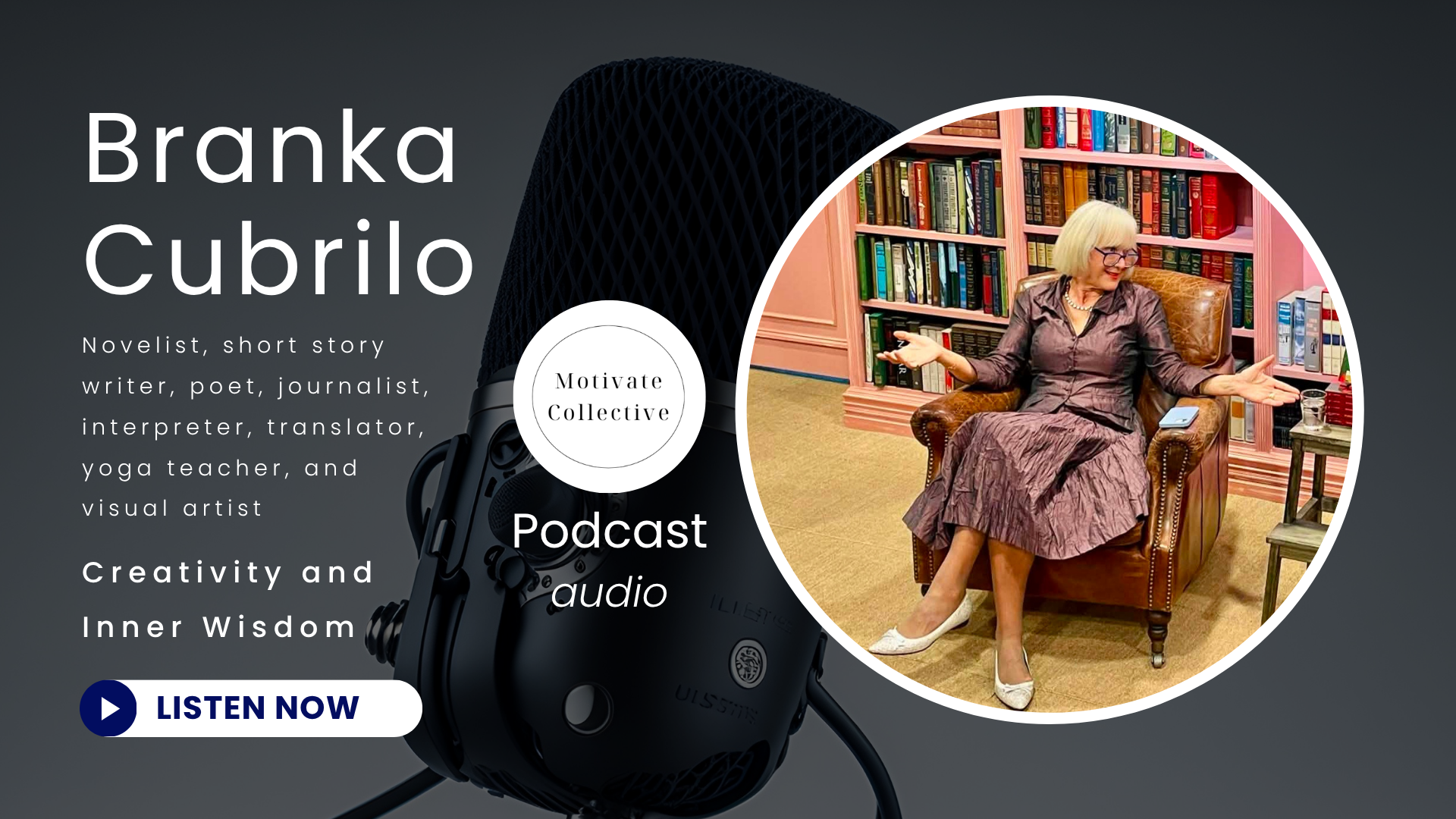
Branka Cubrilo is a multi-disciplinary creative based in Mosman, Sydney. She is a published novelist, short story writer, poet, and journalist who has worked as a broadcaster and producer at SBS and EastSide Radio. She is also an accredited interpreter and translator working across several languages, and a qualified yoga and meditation teacher who has taught for many years. Most recently, Branka has discovered a new creative dimension — painting — producing over one hundred works in just five months. Branka is a member of the Mosman Literary and Art Society.
In This Episode, We Cover
Living a multidisciplinary creative life — how Branka has moved fluidly between novels, journalism, interpreting, yoga teaching, and now painting, often doing several in the same day
Storytelling as human connection — why telling our stories is how we communicate with ourselves and the world
Creativity in pictures — how Branka's imagination works visually, whether she is writing or painting
Social media and the partial self — why what we share online is only a small, curated fragment of who we really are
Radio vs. podcasting — what it takes to hold an audience when they can't see you
Grief and the creative process — what happened when Branka lost her brother and her words disappeared
Painting as a remedy — how over one hundred paintings became a lifeline through paralysing sadness
Writer's block vs. emotional paralysis — the important distinction Branka draws from her own experience
The character who demanded to be written — the extraordinary story of the woman who visited Branka in dreams at 4 am, pressing her to finish her story across 550 pages
Yoga as a lifelong discipline — how a practice begun at nineteen has shaped her work, mind, and body ever since
Inner wisdom as the ultimate creative guide — and why all the answers, ultimately, are within
Special Opportunity for the Motivate Collective audience:
10% off your entire order at HumanCharger
Support your energy, circadian rhythm, and confidence
Code to be used at checkout: THEMOTIVATECOLLECTIVE
As seen on The Motivate Collective Podcast
Get your HumanCharger light therapy headset now.
https://humancharger.com/THEMOTIVATECOLLECTIVE
Listen to the entire episode
Hear the conversation on Spotify, Apple Podcasts, most major platforms, and the in-page player below.
Key Takeaways
1. A creative life can contain multitudes.
Branka has spent decades moving between writing, journalism, interpreting, teaching yoga, and painting — often in the same week, sometimes the same day. Rather than diluting her work, each discipline has enriched the others.
2. Creativity lives in pictures.
Whether painting or writing, Branka sees her work visually first. Characters appear to her. Stories are built from images. This inner visual life is something she believes can be developed through visualisation and meditation.
3. Social media is not real life.
As someone who has been a public figure across radio and literature, Branka is clear-eyed about what social media is — a small, curated fragment of who we are, presented in the best light. Real connection happens beneath it.
4. Grief can silence even the most prolific creator.
When Branka's brother passed away, she returned to Sydney unable to write — not because of writer's block, but because of paralysing sadness. The distinction matters. Sometimes we can't create because we are protecting ourselves from more pain.
5. The remedy may not be what you expect.
Painting was Branka's saving grace — not planned, but led by her inner wisdom. Five months and over one hundred paintings later, she found her way back.
6. Your inner voice knows what you need.
The throughline of Branka's life across every discipline and every creative period is the practice of listening within. Not to noise or other people's expectations, but to the quiet wisdom that already knows the answer.
Quotes from This Episode
"If you are not in contact with yourself, then with what are you in contact with?"
— Branka Cubrilo
"I don't even consider my work as work. I consider it as great time that I dedicate to myself."
— Branka Cubrilo
"It was not as much writer's block as paralysing sadness."
— Branka Cubrilo
"I think all the answers are within. You know, people ask psychiatrists, psychologists, priests, friends. I think you can work that out. Everyone can work that out."
— Branka Cubrilo
"I listened to my inner voice that led me towards finding the right remedy for myself, which was painting."
— Branka Cubrilo
"That's how we connect with the world. We tell our stories for very different, very various reasons."
— Branka Cubrilo
Timestamps
00:02 — Welcome & introducing Branka Cubrilo
00:32 — A life across novels, journalism, interpreting, yoga, and painting
02:11 — Why Branka turned to painting: grief and her brother's passing
04:34 — Why storytelling matters more than ever in the age of AI and social media
06:49 — Looking within: what yoga taught Branka about the inner life
08:30 — Social media as a curated fragment — not the full picture
11:28 — What radio broadcasting taught her about voice, clarity, and presence
13:50 — The flexibility of podcasting vs. traditional media
15:00 — How Branka's creativity works in pictures — even when she writes
18:44 — Showing her most recent painting live on screen
20:00 — What people can learn: visualisation and the inner eye
21:30 — The woman who came in dreams and demanded 550 pages
26:22 — When obsession is not a problem but a calling
28:49 — Growing up in Croatia — discovering Dostoyevsky at twelve and yoga at nineteen
31:00 — Coming to Sydney and opening one of the city's first yoga studios
33:00 — Yoga as discipline, focus, and stress relief in a busy creative life
35:57 — Accepting grief and returning to work
37:00 — What painting lit in Branka she didn't know was there
40:20 — The canvases left untouched through COVID — and what happened five months ago
43:00 — Writer's block vs. emotional paralysis: the important distinction
44:53 — Listening to inner wisdom when everything else goes quiet
47:07 — Having conversations with yourself: a practice for clarity
48:40 — The single lesson from this episode: listen within
The Lesson from This Episode
Listen to your inner wisdom.
When the words desert you, when grief arrives, when you don't know which way to turn — the answer is rarely outside you. It's in the quiet. In the pause. In the voice that says: Find the canvases. Go for the walk. Give yourself what you need.
Branka has lived this across a lifetime of extraordinary creative output — and she offers it not as advice, but as lived truth.
Connect with Branka Cubrilo
Instagram: https://www.instagram.com/branka_cubrilo_author/
YouTube: https://youtube.com/@brankacubrilo4072?si=ThlELKFTPIEo6jXy
Love This Episode?
Share it with a writer, a painter, a grieving friend, or anyone who has ever felt their creativity go quiet and wondered if it would come back.
🎙️ Subscribe to The Motivate Collective Podcast and join our community of purpose-driven people building lives of meaning, wellness, and conscious growth.
🌿 Join the community: www.motivatecollective.com
Transcript
Branka (00:02.382)
Branka, thank you so much for doing the podcast. Thank you, Melanie, for inviting me and giving me the opportunity. You have done so many types of work, and you do lots of types of work now. You've been telling me it has always been that way. Yes. As you know, first I'm a novelist. Published some ten books and several collections of short stories. I'm an ex-journalist. Worked at SBS and East Side Radio. Then I am an interpreter. I work as an interpreter, still active, and a translator for several languages. Then I have a diploma as well in teaching yoga, so I was a yoga teacher, meditation teacher for many years, and in a certain period of my life, I did all of that the same time. In the same week, in the same day. At the same time. Yes, like I can give you example. Early in the morning, I go to SBS and read the news and make feature stories. At midday, one o'clock, I have been booked for interpreting somewhere in Sydney. Then I finish that, come back home, read or edit some of my work that I have written in previous days, or just keep on writing, and in the evening I would go and have a yoga class, teaching yoga.
That sounds like the ideal day. Ideal day, yes. Well, it is an ideal day. I forgot to say that I am, as you know, a painter or artist. I have painted some hundred paintings in the last five months. And yeah, I've been painting a lot lately. A lot. More now. Yeah, more now. Yes. Yes. Pardon me.
Branka (02:11.16)
Look what happened, sad story. Actually, my brother got ill last year, and I went to Europe to spend some time with him. And I was in the middle of the novel, my eleventh or twelfth novel writing. And I left Sydney and went to see him, spent six weeks with him, and he passed away, unfortunately. So when I came back, I just was broken, heartbroken and couldn't get back to writing novels, so I started painting. And I never stopped. So I have painted, as I said, around a hundred paintings and in some online galleries, or we s sort of, I'm preparing, I have some ideas about several exhibitions.
And then you know, the publisher nudged me to finish that novel, and so I have two novels upcoming. And as you know, I teach creative writing, and you know I have public talks in mainly in Mossman Library or Harry Carter bookstore, upcoming one in July, which will be a poetry and literary evening in Harry Hartog, where everyone would have a chance to read something, a little poem, or some sort of prose, or yeah. Everyone can. I mean, you know, we it's a time frame is two hours and w it'll be ongoing basis, once a week. Once a month, sorry.
So yes, you know, like people contact me and they say I'd like to read my poem, or you know, my piece of writing. So, of course, I will select several, up to maybe ten people, who will have a chance to read. And then next time, next ten people. That's the concept. Amazing. Yeah. You're encouraging
Branka (04:34.816)
Lots of people to write, be it with the classes and with these social gatherings. Are you seeing that it's important for people to continue telling stories in this day and age? Yeah, right. Well, it's always important. You know, that's how we connect with the world. You know?
We tell our stories for very different, very various reasons, and I'm a strong storyteller, and I can tell you that this is how you communicate with yourself, with the world around you, and everyone. I think everyone actually can do it in their to their own knowledge or to their own fashion. I do encourage people, I do encourage exceptionally young people to write and to read as well. That's why I run writing courses. Look in the in today's age and time we live in this era of internet and AI, you know. So it's important to write; it's important to keep that skill. What I teach is usually I'm teaching how to connect within a voice, how to connect to the soul, you know, because there are various levels of writings and the way I write, the way I express myself is that way that I wanna connect and I am in contact, you know, like even with my paintings and that's your inner world that you know awaken your inner world, your intuition, your inner knowledge and you know then see what comes out of. Yeah. You're looking within, and you are also a yoga teacher. Do you see that people in general need to look within more after? We are always seeing so much in the outside world. I think generally we are living in the world where we look after so much. You know, we look up to you, you know, in the music industry, and you know we're all the time bombarded by various information and trivial things, you know, so we don't really have time to sit down and ask questions or listen to your inner needs. And we are rushing, and we're neglecting that part of ourselves, which is, you know, essentially the most important part of the structure. If you are not in contact with yourself, then with what are you in contact with? You know, if you're not sure about who you are, then you can be misled. And in today's world, we can be easily misled. Again, as we say with social media, social media is not a real thing. You know, they in social media, a place where we are a small portion of who we are and usually we present that small part in the best light. We have to. And it's nice hearing that from you because you have been a public person on radio and as a writer, and I have been public in other ways. We know you don't want your entire life to be online.
And now people are going onto the internet. Some people put everything on, but I don't think that many people do. So, people browse social media, and they think that is everything, but it's not, is it? Yeah. I mean, it's in a way a dangerous thing as well, you know, because you never know what you are putting out and who is looking at it. As you say, being a public person, you have to guard yourself as well because sharing things that are really deeply personal, I don't recommend that to anyone, you know, because in the end, really, you don't know where that ends. Who has access, you know, I do post quite a lot about, you know, especially my paintings. I do post and, you know, certain things, as anyone else, you know, there are perils in all of that. I think we have to guard ourselves, guard our kids from posting too much. And as I say, it's unreal for me. You know, I like real contact, I like people. I like to sit with someone, talk, and you know, social media is a fantasy world. Even though I like the fantasy world, you know. Like when I paint, I paint my fantasy worlds, really.
But you know, the reality of you know, daily life, the reality of connecting to people, it's something on a different level than what is it social media. I see where you're coming from. I like to share what I can with people, and it's nice if someone is far away, but we can't show everything, and often people eventually realise there's more happening than what they saw on the internet. Yeah, yeah, always. And it's often unreal. It's often not what it is, you know. We have, you know, good days, bad days, we have all areas of emotions, and so can't be always that we're just happy there, and you know beautiful things are happening, and you know you always have the best haircut, you always have everything of the best, and you know that's not real. Yeah. So, it's for me; it's a secondary thing. And we'll look into the painting more. The radio, that's something to look at because
Branka (11:28.99)
Lots of people want to be on a podcast, make a podcast, and it feels a little bit similar to talking on audio. I'm wondering what were the early things you needed to keep in mind when you were starting to talk in that way? Yeah, you know it's different to talk on the radio as a medium and let's say television or because radio people, they don't see you. So when people have the opportunity to see you when you talk, then they get a different impression. They have a full picture of who you are. And it's not like that on radio. So they usually imagine certain, you know, who is that person behind the microphone? But I think you have to be very much more focused; your voice has to, you know, sound much better or more convincing, so there is no smile that you can, you know, like if you make a mistake, you can give a smile, or you can, you know, improvise something if you are, but on radio you can't do that. So I think you know, especially like stations, media houses like SBS or
A B C that are highly professional. Yeah, they don't let any mistakes be made. So yeah, it is much much there should be much away awareness there when you're talking to your audience, then I think yeah. Be aware, and have the clarity and try not to make mistakes. Yes.
It was definitely more strict in traditional media. Of course, these days, people are doing live sessions of all sorts. Yes. And as I say, it's much more flexible nowadays. And then journalism is something completely different today. We have those- how do we call them- like citizen journalists? yeah. And we have podcasters who are actually in completely different professions, and they just decide, and they might be, and there are a lot of them. They are just gifted, you know, orators, talkers, and they, you know, are interesting; they find interesting people, and then they just run their own, you know, little media outlet. So, you know, it's much more flexible nowadays. It is. Yeah. It's so much more flexible. There's so much more opportunity.
And you mentioned, though, that for a while you were doing so much painting because of what happened personally. I'm wondering, although some of us like to talk a lot, what I saw in that story is that maybe you didn't have the words or you needed a break from what you were doing, something visual instead of a whole lot of words for a while. Yeah. You are right. Look, how does my brain operate? I'd say my creativity works in pictures. So even when I write, I see pictures, I see characters, it's just like I see things, yeah? So that's how I build my stories. Painting is very similar. To me, painting and writing is very similar. For instance, the last painting that I did. I get up in the morning with this one. I can show you if you want. Sure, to the audience. I w woke up and I saw this beautiful town all in blue. And I heard church bells actually ringing and you know the whole impression and it was so impressionable that I thought, okay, I'll just go and paint so without breakfast, without even showering that day and when I work so it's not like okay, I'll work today a couple of hours it's not me I work from five or six in the morning till eleven in the evening when I want to create something and so I created this painting, not in one day in three days I think but
Branka (16:16.258)
You know, I see the details, and until I finish every little detail, I'm not, you know, a piece. I think because, you know, it's very difficult to bring to life something that is in your inner eye. Right? There is a picture in my inner are in my imagination that are so clear, the colours are s so vivid and fantastic. And you know, like you have a palette of the colours and you’ve got to make a certain shade yourself. So, if I had that impression of, let's say, a certain blue, and I look at what I have in front of me, that's not that shade of blue. So I have to create it.
So, I'm so keen that I interpret or bring to life every colour and every detail that I see. So yeah, that's how my pictures come together. Like the one behind you that prints, they say that's an auto portrait. I don't know, I just saw that woman. I finished the painting, and my daughter came back home, and she's an artist, as you know, and she looked at it, and she says, Huh, that's you, Mum. And I said, Really? And she said, yes, it is. And then I put it out on Instagram, and people who know me, not everyone, they commented, my god, what a lovely auto portrait, and it's just not like I'm largely obsessed. I was obsessed with moons and a moody sort of atmosphere.
So I went out of that phase, and then I started painting little towns, and you know they're not there. People ask me what are they? Are they you know European towns, are they even Russian churches or they're not. You know, they're there's places that are within me where I reside, my soul, where I, you know, get inspiration, where I retreat to, you know, quiet from the world, where I retreat to get ideas, and yeah, so I can bring it. Do you want I don't want me to show it.
Branka (19:07.918)
So that's the last one that I did. That's amazing. Yay. I love the gold. Yeah, I use gold as well. It's sort of a bit impressive usually. I like gold. The blues. Yeah, the blues. So, so you see, I just went with quite a number of different shades of blues.
And so, you know, like as I said, then I see the little stars there, and it's just surreal. It's something that lives within me. And I like to share that with people. Like, you know, I share my stories and I now sharing my inner pictures. Your inner pictures. Yes. What I'm seeing in your creative process is that you have the picture in your mind, and that's what you are sharing. Whether you are talking about your process now, or whether you are writing a book. Yes. And that is something people can learn. I trust it would have been the same on radio. People have to imagine something they can't see. And now you're imagining something that will then become the painted final work. So people need to learn. What people need to learn is to let themselves visualise things. Do you think it really takes a moment? We have to take the time to stop and see things. Yeah, I think that can be learned. People are born, a lot of people are born with that, you know, ability to visualise, to get in contact with inner voices, but that can be learned as well, like through visualisation, techniques of visualisation, or even meditation that widens, you know, I always had these pictures, even when I was very young or maybe child. I saw everything in pictures, and like when I write, it's, as I said before, very similar, but I see my characters, you know, they appear. I sometimes mention something that probably describes that process the most.
Branka (21:30.863)
Maybe ten years ago, I was writing for one Dutch online literary magazine. I was writing the various, you know, creative pieces, like poetry, essays, short stories. So, I had a written short story called Pia's Poem. Pia is, of course, a woman's name. And I have written that short story, and it was quite popular, you know, a lot of comments underneath that story. Very, she was a poet, a woman and a sort of very mysterious and moody character. And I'm an old, old-school person. I don't talk in words, but I rather talk in pages. You know, people say how many words this or that has. I say I don't know. I can tell you in pages. So that was some 10 to 12 pages; it's A4. And of course, when I published it, it was the done, finished story, but it was not really because after that I had that woman who used to visit me in my dreams. Early in the morning, four o'clock in the morning, usually she would come to my mind or from inside telling me.
Please finish my story. Let's finish that story. Let's say, and I saw the w the her features, and she's quite beautiful, striking, dark-aged, and beautiful green eyes. So she kept on pressing me. It was the winter season like now, and I thought I'm not going to get up now and write. No, no, I wanna stay because four o'clock is usually the time when I write five, and I just continued, and you know, one day I thought, I wonder what she wants from me. Obviously, this is not going to stop, and I sat at my laptop and took me five hundred fifty pages. Wow, yeah, and that she just stood there and narrated the story, and of course, it's not one woman's story. So, there were the other characters, and so it was like, you know, it's such an intense period when I was writing that novel that's called The Dethroned. And as I say, five hundred fifty pages later, she left. Was that recently? Yeah, that was a few years ago. Yeah, I don't remember when Dethroned was published, I think in two twenty eighteen. So it was probably the same year because I even big books I tend to finish very quickly, like in a few months. As I said before, when I write, it's an obsession. It's not what the average human does. You know, I get up in the morning quickly, you know, eat something or, you know, have my chai, and after that I will work the whole day. The whole day, and you know, if I have time to eat, I eat. If I don't, you know, people say, you'll never put weight, or I don't have time to put weight on. Because you're so focused on your work. Yes. I can relate to that so much. There are some days I'm just having sourdough and coffee and just doing things. So sometimes you're just absorbing your work more than food. Look, it's sort of my world, you know, and I like being in that world, you know. I do socialise. I'm not antisocial. Very socialist. Yeah, I am a social person. Pardon me. I'm a social person. But I love the solitude as well. And I love being by myself because then I do create what I want to. You know, we are all creative people, you know, human is created species, and you know, I create all these worlds I think are beautiful for me, you know, through these paintings and the words, and I enjoy it myself, and, you know, selfishly, I can say a lot of things I create just because of myself, for myself. You know, like I used to say before, I write for myself. But no, I write now for an audience as well because I see people like my books, or now, you know, with paintings, I see as well people like some of my paintings. So I think of others as well. But look, I immerse myself there, and I love being there. And that's how it is easy to, you know, write and lose myself ten hours in, you know, such activities. It sounds like it's okay for someone to get obsessed with some work.
But are you saying not everybody is like that? But I don't think, you know, because we are wired differently. Yeah. I think people can do anyone can do that when they find what they love through calling. You know, I don't even consider my work as work. You know, I consider it a great time that I, you know, dedicate to myself. So it's really not work.
Yeah, sometimes my legs are hurting because, you know, I have an easel, or sometimes I stand up, or sometimes I sit because, you know, if you sit for a l long time, of course you have back pain then. If you stand on your legs the entire day, it's not good either. So I combine, you know, I don't write standing up, but you know, when I write, I sit down but change different, you know, chase or even on the sofa, laptop, on the lab. There's a question. Yeah. You're talking about keeping physical comfort when you're working so much. It's clearly a while since you started being a yogi. Yeah. And of course, people have a stereotype about yoga. So how do you still find, of course, your inner connection with self, but also to tie in with what you were saying about physical comfort? How does your yogi past affect you now at this age? In present. Yes. In present. I started with yoga when I was very young as well. I think I was nineteen, which was a long time ago. When I was nineteen. why? I don't know. You know, I grew up in a town that wasn't too big, neither very small. Yeah. Middle-sized European.
Melanie: Where were you?
Branka (28:49.198)
It was called Rijeka, a small town in Croatia. In Croatia, yeah. And it was, you know, in summer great place, but apart from summer it was a boring place. Not much to do, to be honest. So someone brought yoga, and I was always curious. I always had a curious mind, you know, like I started reading Dostoyevsky when I was twelve, you know, because I really wanted something deep and substantial, and you know, like someone told me about yoga, like I think you would like that. So that's how I found actually yoga and I did yoga there for quite a number of years with the same yoga teacher. And then I came to Sydney in the early nineties and, you know, I came with solid English, but you know, it's hard when you come; it's a different world. You don't know where to find a job and what kind of job, and you know, if English is not your first language, then you can't work in journalism, for instance, or you can write in a different language. So, I was thinking what shall I do? In a way I was lucky because I was one of those migrants that I wasn't in the position that I have to go to work, which was great. So, I thought, what shall I do now? And then I thought, no, I might enrol in some sort of yoga teaching course because that was what interested me back then, and that was the time when I had enough time for myself, and that's what I did. And what was it called, yoga institute, something like that? That lasted a couple of years. And I got a yoga diploma diploma of yoga teacher, and I opened the first. That was actually the first yoga studio in the city. It was in York Street. And I was teaching there for a few years. Then I got a job at S B S, and that was my serious job in terms of, you know, making even money because, as I said, I was a migrant and you need money to live. And it was much more, you know, a serious job. But I kept teaching people and doing yoga because I discovered it's a really helpful technique for everything. I was young back then, you know. So, as a young person, you don't have health issues I never had.
And you know, I discovered this fantastic discipline to keep you healthy, keep you fit, curious as well. Those beautiful techniques that you can, you know, that help you and show you how to get in, you know, like meditations and how to find peace in the busy world. So I kept this discipline because, look, I'm very sort of I can't say a regimental person, but I like this, yeah. So, if you are a professional, you need this- you need, you know, say, I’ve got to finish this novel- or, you know, especially when editing is in question, it's something that's boring. You have to have discipline to sit every day, and yoga gives me that. So, how do I keep myself healthy or in good shape for that kind of work? Long hours of writing and painting. Yeah, I do have a break in the evening, and I do my, you know, yoga stretching, and you know, I calm my mind. There's not much need to calm my mind if you paint the whole day, that's already meditation, but yeah, I use these techniques to keep me in a better shape and my mind sharper. So you still do a physical practice even now? Yeah, I do. Yeah. I do. Yeah, as I say, you know, like sometimes I feel that's too much stress on my back. And I know how to r really pa release the pain, or you know, just make myself feel better, ready to go to have a, you know, peaceful night. Absolutely. It's inspiring to know that the yoga practice helped you when you were in the media, and even afterwards, it really helped. Yeah, yeah. Especially in the media, you know, like it's a stressful job. Yeah. Especially with the deadlines and, you know, especially if there's a live program and yeah, yeah, I think meditation always, I say, helped me, but, you know, it was a great tool. It was a great tool to, you know, keep me focused and, you know, not really stressed out. Do you think people need a variety of tools then when work is stressful? Yeah, it is individual, you know. I don't say that yoga probably would work everyone I don't know, you know, like as the yoga when I was teaching yoga, you know, there were people who would be delightful that they found yoga, and they said it really helped. And there were people who were not, you know, that wasn't the right vehicle for them, and they would say, I have people; they say it's boring, like I don't know what they want, you know, like all relaxation people, they fall asleep.
You have the answer, yeah. All right, we can go home now. Yeah, it's not for everyone, you know. Some people find different things, you know, some people like pumps. You know, a couple of beers or something. You know, there are various techniques from the East or the West, so it doesn't matter. You know, like people they like Tai Chi, or and they find they are that's right. And then some people like running, but you know, as long as you find something that works for you, I'd say. Yeah. Even painting, you know, some people paint, and I think painting actually is a great, great tool to yourself and to express yourself, to meditate. Yeah. Yeah. You know, it really helped me to go through there.
Branka (35:57.687)
Only painting. So, I feel now, you know, I accept it actually. I can't say I feel better because with such a loss, you never get over that. But you accept, yeah, you accept. And I accepted it, and I am now ready. As I said, I have two novels. One is ready to be published very soon, and the one that I was writing when that happened last year, I'm about to finish. So yeah, plenty of work, and I called it your time. It's my time. It's your time. You look so happy talking about the painting. Yeah, yeah. It brought out of me something that I wasn't aware of that day, that's why. I'll tell you now. I can be very existential in my writings and quite you know, I go into deep human questions and suffering and I come from the country where we had a war as well and you know understand I understand dark side of human psyche and I explore that and I write about that and so sometimes the writing for me can be exhausting, can be emotionally demanding whilst and you know it comes in very various tones, dark tones often. And then when I was in that dark place, coming back after my brother's funeral, leaving my mother behind, heartbroken, I couldn't write. My words just deserted me. But the other thing was I didn't wanna get back into that darkness, or I mean, no novel is pure darkness. I'm not talking about that. But you know there were yeah, there were heavy stuff in it. So I thought I'm not ready for that. And I'll tell you now about a little short history about my paintings. When I was a child, I painted. And I was drawing. You know, rainy days at home. As I say, my hometown was a boring place, you know, so I would stimulate my mind and create my rich worlds in my four walls.
So one way was painting, drawing, and writing poetry as a young girl. And I loved back then painting and drawing and when I was young I was thinking that I will enrol in the art school. And you know, somehow I did not, life took a different turn, and I started writing very young. I was seventeen or eighteen when I got awards for my first novel and that was a great stimulus to keep on guarding and my heart was completely inked. COVID time came and lockdown, and you know we were home and
I live with my daughter, the two of us, and Kat Mia, probably she will be visitor. And you know, my daughter said, Mom, let's start painting together. So she bought a canvas season paint. And I was reluctant because I was back then I was writing book in English and book translating one book in Serbian language.
Branka (40:20.152)
which was published in Serbia. So, two books were happening back then. And I said to her, no, no, I have too much work. I don't want to. So, we just kept these canvases somewhere in paint, and so five months ago, when I came back to Sydney, my beautiful home
One morning, I got up and thought, "Where did she put these canvases and paint?" Just that. You know. And I found it and started painting. You know, after you know, after that, day after day, day after day, and you know, then these vivid pictures that I said that I have, you know, in that period when my brother passed away or when I came back home, internally nothing was happening. It was like a deserted land inside, just sadness. And I didn't have my beautiful dreams that I usually have, very colourful dreams. It was a barren land, you know, very, very bleak, and I would just get up very sad in the morning and unmotivated to write. I'm unmotivated to do anything, so I can't say I had any picture and then say, "Okay, I wanna put that in case I had nothing there.” Was sort of numb. But you know I had an idea. I thought, “Where are those canvases and paints?” So I took first canvas out sit on the kitchen table, actually. And I started doing it and, you know, putting it online, my Instagram usually and Facebook and getting great feedback from my friends. They said, I didn't know yourself great. I said, I didn't know myself. You didn't know. But look, you don't know really until you do it.
Branka (42:34.402)
Yeah, absolutely. You know, I know that I'm sort of capable of producing something, but you know, and then you know, the more you do it, of course, the better you get at it. But you know, like I do everything from that level, as I said, and I teach from that level. It's a level of soul.
I am in contact with my own, so I listen to my inner voice all the time. Whether it is my work or any social situation, whether it is a partner, any kind of relationship, I listen. I attend to listen to my inner voice, and I do follow it. So it was like with it on the first day when I decided to paint again.
And it is now every day when I paint, I just let go, and it comes, then what it comes, and then sometimes I think, Wow, that's all right. That's amazing. I'm seeing encouragement that it's okay to have writer's block. You could almost call it that. The words were gone. You know, that's funny. So now I'll tell you. Because often I was in interviews, people ask me about writer's block, and I was always sort of cocky, telling them it does not exist, it's procrastination, and people still believe that if you write on a daily basis, then you know you'll overcome that so-called writer's block. But I think that was actually not as much writer's block as the paralysing sadness. You know what I mean? I really barely cooked for myself. You know, like when you're reluctant, you're reluctant to do anything for that certain period of time. But I was just lucky that I listened to my inner voice that led me towards finding the right remedy for myself, which was painting. I wasn't, as I said before, it was like a barren land. I was more reluctant to get somewhere where I don't wanna be, you know, explore emotions that were already raw and painful. That's too much. Yeah, it was too much. So that was, you know, a God-given remedy to you, know, and then everyone encouraged me. Yeah, yeah, keep on painting, and then I think, well, I can't do both, painting and writing at the same time. But actually, I can if you split the day into two activities. But I was really obsessed, as I say, maybe five, six months of just, you know, communicating through colours. That's through colours. What I'm hearing is that what I'm hearing is that you felt paralysed, and it's about not doing anything. So it's not necessarily writer's block. It's that people can have a moment of just not being able to really do most things. But then the lesson, and this is something I've learned from you in this moment, the lesson is to do something that you can do because I felt that way in the past week. I felt like a part of me had switched off from almost everything that I could do, some things, the essential things, but not everything. Yeah. I think again, you know, that we all have that inner wisdom. And we all know what's best for us if we listen to it. I mean, it's easy to say rather than, you know, experience, and there is a long way to get into your inner wisdom. But I think everyone can sort of, you know, dedicate a certain amount of time, five minutes or fifty minutes talk to themselves, to ask themselves what is going like talking as with a friend, you know, to talk your to ask yourself, where are you at? What hurts? How? How can you help yourself? And you know, s so I have often, for years, had conversations with myself. And you know, like I think it would be great now to go for a walk down Balmoral, and then there is another voice who says, no, don't. It's cold, or it's too hot, or who wants to walk now? It's nice and comfy. But you know, then there is that w wisdom, the other voice telling, No, no, you do what's best for you now. So you know, I learned to do things that are in my best interest.
So, I put a sneakers on and I said, “Okay, go for a walk.” Your legs after a long day of standing need good walking or sitting, you know, after sitting. So I think that's important. That's my message: always listen to your inner voice, and once you find the right thing for yourself, that's a reward. Listen within. Yeah.
Listen, listen to what your inner wisdom has to tell you. Yeah. That's the great lesson from this episode. Listen to the inner wisdom. Yes. Listen to the inner wisdom. Thank you. I adore how we naturally reached that lesson, and I always ask at the end of episodes, "What's something someone could do?" and you knew. You knew exactly when we needed to give that one piece of wisdom.
And the lesson. And the lesson is simply people need to look within. Yes. Yeah, I think all the answers are within. You know, people ask psychiatrists, psychologists, priests, friends. I think you can work that out. Everyone can that out. And after, you know, like a really difficult period in my life, I could say, you know, I keep on, I will keep on writing.
Branka (49:30.69)
But then I listened to that voice and said, "I'll take time now to paint," and that was my saving grace. That was. Branka, thank you so much. Thank you, Melanie, for giving me the opportunity.