Robyn Flynn, Canadian Podcasting and Radio Host and Producer, Discusses Storytelling & Standing Out Online
Table of Contents
Meet Robyn Flynn
Making History in Sports Radio
From Live Radio to Podcasting: What Changed
The Most Underrated Skill in Podcasting: Microphone Technique
How to Handle Overlapping Talk and Guests Who Won't Stop (or Won't Start)
Where to Draw the Line on Difficult Topics
Why Scripted Corporate Podcasts Fail
Repurposing One Episode Into a Content Engine
Making the Most of TikTok and Social Trends
Politics, Money, and Public Figures Who Actually Do Something
Being Relatable Without Complaining
Online Harassment, Thick Skin, and Protecting Your Mental Health
Privacy, Kids, and the Permanence of the Internet
Getting Started as a Podcaster or Podcast Guest
Content Note & Support Resources
About Robyn
Links & Resources
Content Note
This episode includes open discussion of online harassment and threats Robyn experienced during her radio career, references to sexual assault, and mention of a criminal trial involving the death of children connected to postpartum psychosis. These topics are discussed candidly and are not the central focus of the conversation, but listener discretion is advised.
If you need support: 🇦🇺 1800RESPECT — 1800 737 732 🇦🇺 Lifeline — 13 11 14 🇦🇺 Beyond Blue — 1300 22 4636 🇦🇺 Blue Knot Foundation (trauma & abuse support) — 1300 657 380 🌍 International listeners: RAINN, Crisis Text Line, or findahelpline.com
Guest Bio
Robyn Flynn is a Montreal-based podcast producer, storyteller, and founder of Studio Quinze, where she produces between eleven and fifteen podcasts at any given time. She also runs Robyn Flynn Media, offering podcast production, social media management, and content strategy for creators and brands.
Robyn spent over a decade in broadcast media, most notably as co-host of She's Got Game on TSN Radio 690 — a nationally syndicated radio show dedicated exclusively to women's sports, and the first nationally syndicated sports show in Canada hosted by a woman. She has also worked as a play-by-play announcer for the Canadian Women's Hockey League, a contributing writer for The Athletic, and a producer for CJAD 800 Montreal, including The Aaron Rand Showand Montreal Now. She studied Professional Theatre at Dawson College and English/Language Arts Teacher Education at McGill University.
Today, Robyn brings her broadcast journalism background to podcast production and coaching, helping clients master everything from microphone technique to content strategy and social media repurposing.
Episode Breakdown
(Timestamps approximate — confirm against final edit before publishing)
00:00 — Welcome, and celebrating Episode 98 of The Motivate Collective
00:49 — Audio vs. video podcasts: why there's still a strong appetite for audio-only
02:57 — Making history: the first nationally syndicated women's sports radio show in Canada
04:41 — Why Robyn moved from radio to podcasting, and what she took with her
08:22 — Microphones, budgets, and why "a microphone is a microphone"
10:01 — The most overlooked skill in podcasting: mic technique
13:01 — Coaching podcast guests — why people underestimate how much technique matters
14:41 — Talking over each other, and the radio trick for interrupting cleanly
18:39 — How to know when a topic is too much for the show — and when it isn't
19:43 (content note applies from here) — Covering hard news, misinformation, and where Robyn draws the line
24:25 — The corporate podcast horror story: over-scripting and why it backfires
25:52 — Why heavy legal oversight usually means podcasting isn't the right medium
29:35 — Social media as part of the podcast production process
30:52 — What it actually takes to go viral
32:58 — Repurposing one episode into blog posts, clips, newsletters, and more
34:12 — Making the most of TikTok as a first-person platform
37:53 — Politics, privilege, and why "I'm not political" is itself a position
41:27 — Talk vs. action: the difference between complaining online and creating change
46:59 — Why the public wants to see public figures as relatable, not perfect
53:51 (content note applies from here) — Vulnerability, addiction, and connecting through hard topics
56:29 — Online harassment, threats, and building a thick skin as a public voice
1:01:27 — Why we mistake the public "version" of someone for who they really are
1:03:11 — Kids, digital footprints, and consent online
1:05:35 — Why nothing on the internet is ever truly private or truly deleted
1:07:51 — Practical advice for anyone starting a podcast or becoming a guest
1:09:46 — How to figure out what you actually want to say
Key Insights
Microphone technique is one of the most undervalued skills in podcasting, and one of the fastest to fix — Robyn's rule of thumb: imagine a magnet between your mouth and the mic.
Radio and podcasting reward different instincts. Live radio trains you for urgency and quick pivots; podcasting rewards patience, flexibility, and knowing when not to release something.
Over-scripted corporate podcasts fail because authenticity is the point. If a brand needs every word vetted by legal, a podcast probably isn't the right medium — paid ads or traditional marketing may serve better.
One episode is a repurposing goldmine — Robyn points to blog posts, multiple social clips, newsletter content, and website backlinks all coming from a single conversation.
Short, out-of-context hooks outperform long clips on social media — the goal is enticing a click, not giving the story away.
Being relatable as a public figure is about showing normalcy, not complaining — audiences have little patience for hearing wealthy or powerful people air grievances.
Online harassment is a real and serious cost of visibility. Robyn speaks candidly about threats she received during her sports radio career and the steps she's taken to protect her safety and mental health — including leaving platforms that no longer felt safe.
Nothing posted online is ever fully private or fully deleted — Robyn's practical filter: if you wouldn't put it on a billboard, don't post it.
The biggest barrier to starting a podcast is rarely technical. Free tools exist for nearly every budget — the real work is figuring out what you actually want to say and how to stand out.
Guest & Community Links
Robyn's LinkedIn: linkedin.com/in/robyn-flynn-25a3a0125
Studio Quinze: LeStudioQuinze.ca
Robyn Flynn Media: [linked via LinkedIn company page]
🌿 Join The Motivate Collective community for more conversations, events, and resources built around growth, wellness, and conscious living: www.motivatecollective.com
Transcript
Guest: Robyn Flynn Episode number: 98
Note: Grammar, false starts, filler words, and duplicated words have been cleaned up for readability. No wording or meaning has been altered from the original recording. Timestamps below are drawn from the source file and should be treated as approximate until confirmed against the final edit.
⚠️ Content note: This episode includes discussion of online harassment and threats, sexual assault, and a criminal trial involving the death of children linked to postpartum psychosis. Listener discretion advised.
Robyn Flynn (00:00): Yes, me too.
Melanie Suzanne Wilson (00:03): The fun conversations in podcasts. First of all, introducing to the audience Robyn Flynn — welcome to the podcast.
Robyn (00:12): Thanks so much for having me, Melanie.
Melanie (00:15): I am so excited you are episode ninety-eight. I know, I know — we're going to have a celebration in Sydney for one year and a hundred episodes, I never expected that. But this is about you, and we've been talking so much before we started recording that I just clicked record, because you make podcasts and there's a lot to talk about with that. So we'll just keep chatting about what we were chatting about.
Robyn (00:49): Yeah, it was funny — we were just talking about people who do audio versus video podcasts. At any given moment, I'm usually in production on between eleven and fifteen different podcasts, varying in frequency — some release weekly, some monthly, everybody's kind of different. But you were surprised that there are people who still do audio-only format, and there is still an appetite for it. My background is radio, so I totally understand wanting to be heard and not seen. There's still definitely — I mean, that's how I prefer to consume podcasts. I don't watch them, I listen to them. I'm a purist, I'm old school.
Melanie (01:29): The listening — that's something a lot of people have done for a long time. And today, if they're doing something else at the same time — driving, cleaning up —
Robyn (01:41): Yeah, exactly. I mainly listen to podcasts when I'm driving or in bed — before I'm about to go to sleep, I'll put one on. That's usually when I listen the most. But there's a handful of video podcasts I watch and prefer in that format — they don't even feel like podcasts, they feel like talk shows. I love Call Her Daddy, Alex Cooper — I watch religiously every week, obsessed. I also love the New Heights podcast because I'm a huge Swiftie, so anything remotely Taylor Swift adjacent, I'm on board. For the most part, I really like Oprah's podcast too, and even any polar-opposite ones, I enjoy the video content. I don't always watch it — sometimes I listen — but for the more niche podcasts I enjoy, I'll listen over watch. That's my preference.
Melanie (02:33): Absolutely. I get a bit obsessed with watching or listening to particular people who are guests on shows — anyone telling a story about how they got to where they are, which is part of why I like doing this, and also people who've done something a bit unprecedented.
Robyn (02:57): Yeah, that's definitely my jam. I mentioned I came from radio — I actually worked in sports radio, which I don't know is like in Australia, but there aren't a lot of women who work in sports in North America. And if they do, they're usually the "hot sideline reporter" — that's sort of how you get pigeonholed. That's not me. I don't wear makeup every day, I'm plus size — I think I'm beautiful, but I don't fit that mold. So it was kind of shocking for people when I went into sports media and didn't just want to be a reporter — I wanted to be a talk show host, have opinions, strong opinions. A lot of people don't like that. I had to work really, really hard — you have to know twice as much as the guys to be taken half as seriously. But I did push, and eventually I got my own sports radio show. It was nationally syndicated across Canada, and it was the first nationally syndicated sports show hosted by a woman in the country. This only happened six years ago — it's very recent history.
Melanie (04:00): My goodness, you made history.
Robyn (04:03): Yeah, I did. And not only was it the first nationally syndicated sports show hosted by a woman, it was a show about women's sports, which is historically undercovered, underfunded, underserved in general. So I really checked all the boxes with that one.
Melanie (04:22): You really did. I can see that you genuinely love what you do, and I like talking with anyone who's breaking a record, making history, doing something out of the norm, because they genuinely love the creativity of it.
Robyn (04:41): Yeah, that definitely describes me. I love what I do so much — I loved working in radio from the time I was a little kid. I used to have a tape deck and record the radio, the music station, and then the little breaks where announcers would speak, I'd record over it — time it, see how long it was, then record something so I could host my own radio show. That was literally all I wanted to do. So getting to work in radio was quite literally a dream come true. I absolutely loved it. But radio hours aren't conducive to having a family — you're either working the morning show, on air at 5 a.m., so at work by four, up at three — an insane lifestyle — or the afternoon drive-home show, at work till 7, 7:30. Trying to find childcare that isn't a private nanny or a daycare, it was just unaffordable for what I was making. So I had to make a choice, when I had my daughter, to step back from radio. I'm really fortunate that I left on great terms — I still get to fill in, like next week I'll be filling in at the radio station a couple of days. It's a lot more sustainable — easier to find childcare for two days than every single day. So I enjoy that, because I still get to do it. But I took those skills and thought, okay, what do I know how to do? I know how to tell stories, and I understand the technical side because I worked with all that equipment for years. So podcasting felt like a natural evolution. And honestly, it feels like the right choice, because I think fewer and fewer people are listening to the radio. It still holds a special place in my heart — personally, if I'm stuck in traffic and don't know what's going on, I'll turn on the radio to find out if there's a huge accident or something. So I still think there's value in live local radio, but the listenership is dwindling — everybody's moving over to podcasting. So I went with it.
Melanie (06:42): You went with it. We're listening to things online, but is it similar enough to what you were doing?
Robyn (06:50): Yeah, there's less urgency. At the beginning it felt easier to me because I was used to live radio — if your guest is two minutes late and you only have seven minutes to talk to them, well, now you only have five, and you need to fill that airtime where they're not answering their phone because you're live on the radio. Whereas with podcasting, if someone's a couple minutes late, no big deal. If you need to reschedule, no big deal. If a guest doesn't show up when you're live on the air, you need a backup plan — something else, and it can't just be the host talking about nothing, it has to be interesting or people are going to change the station. So it definitely felt higher stakes — breaking news events, you could have a whole plan for your afternoon and then suddenly there's a shooting, or a huge trade with the local sports team, and everything you had planned is thrown out the window because you have to pivot. So it was higher pressure, higher stakes, which is fun, but really difficult on your nervous system at times. I find podcasting personally a lot more chill — it feels like no one's going to die on the table, everything's going to be okay. But in terms of the transition — good storytelling is good storytelling, no matter whether you're watching TV, listening to a podcast, listening to the radio, whatever — if it's a good story, you're going to keep paying attention. So I think that skill definitely transferred over. And obviously the tech stuff is very similar — a microphone's a microphone.
Melanie (08:17): Yes. Okay, so the microphones are similar enough.
Robyn (08:22): Definitely. I mean, there are a million different kinds of microphones out there — dynamic, USB, XLR, depending on your setup. At this point I feel like I've used them all. But for the most part, a microphone's a microphone. I think it's more accessible now — it used to be harder to go out and buy a microphone and have a home studio, that used to be a significant investment. Now you can get away with a pretty cheap mic from Amazon and have something pretty decent.
Melanie (08:54): Amazon — I went as cheap as possible. I had to replace my mic with the same sort because I know what I like. It's a cheap brand, and someone was getting rid of it for twenty-five dollars Australian.
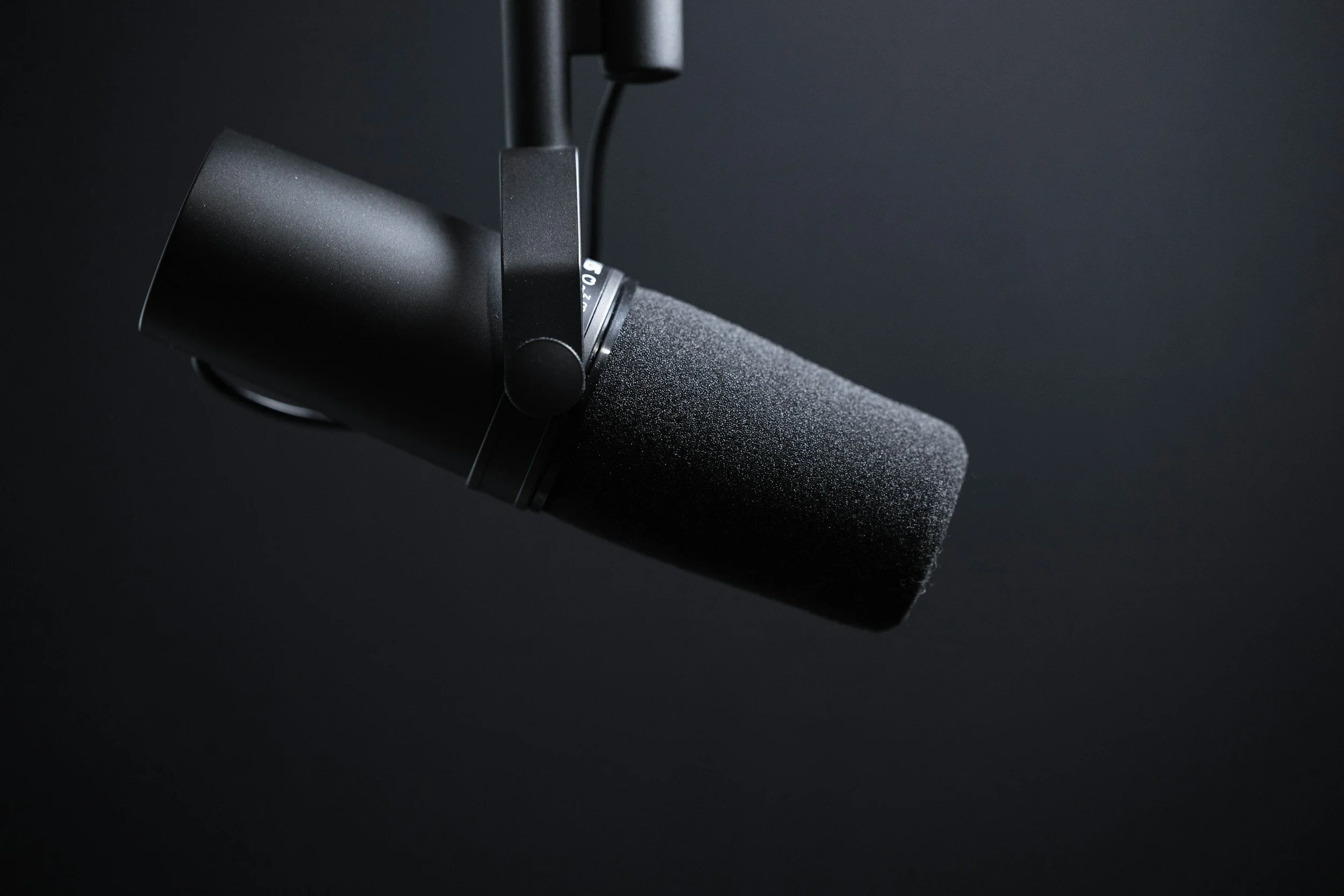
Robyn (09:11): Nice, I love it. It depends on the context too — I have different kinds of microphones. At home I use my Shure MV7, huge fan of that one. At my podcast studio, which I own, we have RØDE PodMics, because I have the RØDECaster Pro as my soundboard, so it made more sense to use RØDE PodMics. When I'm on location with a client, we're just using cheap lav mics and they sound great — you really don't have to break the bank, as long as you know what you're doing. I think people really sleep on mic technique. That is a huge issue.
Melanie (09:54): I love this conversation so much — microphone technique, the technique of talking into a microphone.
Robyn (10:01): Yeah, have you ever been to a conference or a TED Talk, and somebody has a microphone — they think that because they have a microphone in their hand, now everyone can hear them, so they're talking and looking around, and every time they turn their head, we lose them, and people are like, "We can't hear you." You really need to keep that microphone in front of your mouth. At the studio, when I'm coaching people who are sitting down for their first time doing a podcast —
Melanie (10:10): I know where this is going.
Robyn (10:31): I always say, imagine there's a magnet in your mouth and the microphone — it has to be in front of your mouth at all times. If you turn your head, the microphone needs to come with you. If the mic is stationary and you turn your head, instead of going off mic, turn your head so your mouth stays in front of the microphone. And I'll adjust the mic to bring it closer to people, and they instinctively lean back — people are afraid of it, I don't know what it is. But truly, if you use a microphone properly, you can use any microphone and it's going to sound good.
Melanie (11:04): You can. A couple of things there — firstly, I hear you so much. I'm a speaker, and I was lucky enough a few months ago to MC a conference. The unexpected thing that was easy and instinctive is that I was guiding corporate professionals, bureaucratic professionals, people who know their thing, with the microphone, similar to what you were describing. I found there's a one-directional microphone where you hold it and the sound goes in a straight line, not from other sides, and then there's one that's any-direction — but it also means people are just holding it any way. I'll say this verbally in case someone is only listening: they might have been holding it up straight, like a sign. How can we explain this — you needed to hold it kind of like — how can I compare this — like a drink bottle, if you're going to drink from a drink bottle.
Robyn (12:17): It's directional — it's like lipstick. If you turn your lipstick to the side, you're not going to get any product on your lips — it has to be directionally facing your mouth to get the lipstick on your lips.
Melanie (12:29): Yes, yes, absolutely. Or a straw — you don't just have the straw up and down in front of you, or you won't get anything. That's something everybody needs to learn, and I'd happily advocate with you to drum up demand for teaching that, because I think people don't know what they don't know. Do you find a lot of people don't realize there are a few simple hacks — not difficult, just a few different ways to talk into the mic?
Robyn (13:01): I think the biggest challenge truly is that people undervalue it as a skill. They think, "How hard could it be, I don't need a tutorial, it's a microphone." They don't think it's difficult — "I have a microphone, whatever, and I speak." So I lead workshops all the time on how to be a good podcast guest, because a lot of people find themselves invited to be a guest on a podcast — they may not have their own, but they have an area of expertise or a story to share, and they get invited as a guest. I have a whole section of my workshop on mic technique, and as I'm talking, I can see people stop taking notes — you can tell they don't think this is important or relevant. That's why I'm a huge advocate for getting hands-on with the microphone, not just a dead mic — let's literally pass around a microphone that's mic'd up to the room, so you can hear the difference as you're speaking, get them to talk for a while, not just "check one, check two" — start telling me a story, and notice how, as you get engaged, your body language shifts and the mic dips a bit, so you have to be more conscious of it. Once they actually see and hear that in practice, I find it a bit easier. But in general, people just think, "yeah, yeah, whatever," they don't take it seriously — kind of like when you're flying on an airplane, it's your twenty-thousandth flight, and the flight attendant is telling you where the exits are, and you've already put your headphones on and you're not paying attention, but it's very important information, and if anything were to happen, you'd probably be freaking out.
Melanie (14:30): Absolutely, you would. You want people to hear you. Do you find people need a little bit of guidance on how to talk clearly as well?
Robyn (14:41): Yes, definitely. In addition to not just speaking clearly, people naturally mumble — that's just how human beings speak. It's more about not talking on top of other people. On a video podcast, it's a little easier to decipher who's speaking. But if somebody's only listening and suddenly there are two competing voices, one on top of the other — and that's assuming it's just a host and a guest, sometimes there are two hosts, three guests, you don't know what the format could be — it's unlistenable. This was something I learned in radio: don't interrupt or talk on top of each other. If you have to interrupt, because you're running out of time and need to go to commercial, the guest needs to stop talking. Competing — I think of political debates when everyone starts talking on top of each other, we're not getting anything out of it, it's so frustrating to watch. So always put yourself in the position of the person listening: is it more important for you to interrupt and make a point, or to prioritize their listening experience? Because they might just get fed up and turn you off, and you don't want that.
Melanie (15:47): It's nice to find a way to inject yourself into the dialogue, put that wedge in without fully overlapping. I agree, it's annoying trying to edit things when people have overlapped. I can confess that because some podcast guests talk a bit longer, or I really want to get the topic in a slightly different direction, I need to insert my voice, and I'm curious how you handle that — I'll say a "sorry" or "sorry to interrupt," but how do you handle it when you need someone to pause for a second?
Robyn (16:41): In live radio, I can "pot them down" — as I'm speaking and want to interrupt, I can literally drop their fader so the listener can't hear them continuing to speak. Find a natural place to insert yourself, the end of a sentence, kill their fader, and then interrupt — so it sounds more seamless. That's a little behind-the-scenes radio magic.
Melanie (16:56): Nice.
Robyn (17:00): From a podcasting standpoint, I'd again wait for a natural interjection point — they finish a sentence, I interject, give it a pause, literally say "sorry to interrupt you for a moment," and then carry on, so I can cut that part out — it'll sound a lot better to your listener than jumbled talking.
Melanie (17:17): Yes.
Robyn (17:22): But I agree, some people tend to run on — I've had guests where you ask a question and they go on for ten minutes, and okay, podcast over. It can be really frustrating. But equally frustrating is someone who doesn't have a whole lot to say — you ask a question and get a five-word answer, and it feels like pulling teeth.
Melanie (17:39): So much compassion for that. How often do you get someone who doesn't have much to say?
Robyn (17:45): In radio, often, because you're frequently speaking with press attachés or spokespeople. I'm based in Montreal, so I worked in English radio, and very often we'd have French-first-language speakers coming on and speaking in their second language, so it's natural they'd struggle a little with the language. Don't be afraid to cut it short — I think very often people have decided "this is twenty minutes, I'm going to do twenty minutes." If you don't have twenty minutes' worth, stop — it's going to be boring if you try to continue. At the radio station we'd have ten minutes for an interview and be done in five — we'd wrap it up, and I'd always have backup topics I could discuss, because you're live on air. With a podcast, you can just wrap it up and not release it if you don't want to — if it's not very good, don't release it, you're under no legal obligation to.
Melanie (18:39): Speaking of not releasing footage — okay, I'm thrilled to ask about this, because very, very rarely I've had someone on the show say something so intensely traumatic or controversial. I adore those people so much, but I had to check: is this more than the audience could handle, to the point where maybe I'd get censored, maybe it's putting people at risk — we're talking about people in a story dying in a particular way, or people committing crimes. I'd say a lot of listeners might not realize that on a podcast you hear about anything, at least for a social one like this. Was it like that in radio — did you get people talking about things so intense you had to draw the line somewhere?
Robyn (19:43): Yeah, I was a talk show producer at a news radio station during the early days of the pandemic, which was very, very controversial. Where I live in Canada, we had some of the harshest restrictions in the world — we shut down borders, had curfews, vaccine passports to go to restaurants and concerts, it was really strict. With all the misinformation going on online, there were some very hot-button moments. You do your best to keep it respectful. I personally don't think any topic is off limits — I'm in production on a podcast right now about the Israeli-Palestinian conflict, I've done podcasts with sexual assault survivors, shooting victims. I think any topic, if it's well covered and you include trigger warnings in your show notes or links to resources, is fine. Honestly, the only kind of content I wouldn't share is if it was boring — if it's really short answers going nowhere and not interesting, that's the content I'm not sharing. I'm not trying to be salacious or clickbaity — I'd be mindful of what clips I'm sharing on social media, because I think those platforms are more likely to censor content than podcast platforms. I'm obviously not going to platform racist or super sexist people — truly, if somebody said stuff like that, I'd prefer to challenge them on those beliefs than censor it altogether. I think that's more interesting to listen to than just shutting the conversation down. I haven't had to struggle with it all that much. With radio, you have to worry about language — you can literally cut them off if they're swearing, you're off the air. But with podcasting, it's a bit more of the wild west — you can kind of say and do whatever, as long as you're responsible about it. I think it helps that I have a journalism background — I'm able to push back on people and not just take what they say at face value. I understand journalistic integrity and the right and wrong way to tell a story, and I think that's lacking in the podcasting space — a lot of people say and do harmful things irresponsibly just because they don't have that training. So I feel fairly confident in my ability to safely share information.
Melanie (22:13): One of the best things people learn in journalism is human interest and the values of storytelling. Do you see that normally translating when you're doing more corporate podcasts? I ask because we're still humans, even listening to something corporate, and it has to catch our attention.
Robyn (22:38): In certain ways radio is a lot easier, because you're getting immediate live feedback from people — they can call in, text the station, so you have a good sense of whether you're hitting the right mark. But with a corporate podcast, especially with layers of approvals, it's very often that the person you're dealing with has to share the episode with their boss, then there's a legal team that needs to vet it, and a marketing team — once you have too many cooks in the kitchen, the product is diluted. So I usually tell clients to assign one final key stakeholder who has ultimate say, because if we're going through rounds and rounds of revisions, I'm going to charge extra. Something I often get from corporate clients is they'll listen to the podcast, decide they didn't like an answer, and want to re-record just that answer, insert it in. I always explain: this is going to sound awful — your tone of voice could be slightly different, maybe we recorded that in the morning so you're a little hoarse, and now we're re-recording the insert at 3 p.m. when your voice is fully warmed up, or maybe you're in a different room, or it was winter versus summer, so there's a hum of an air conditioner in the background we'd have to reduce and there's echo — it's never going to sound identical, because it isn't, it was recorded on a different date. So are you trying to produce a commercial for your business? In that case, I'd suggest buying paid ads, or getting a billboard. If you're going to commit to the medium of podcasting, keep it conversational — and that's the thing I think corporations struggle with most, they want copy, exactly perfectly crafted answers. And then maybe podcasting's not for you, truly.
Melanie (24:25): I was so keen to share with you the most bizarre experience I had with corporate podcasting. A good-intentioned person in medicine who feels successful — this medical doctor stayed up until 2 a.m. scripting every word he wanted in the podcast, but only told me that was happening after I arrived. I thought it was going to be a conversation like this. I show up, and there are precise words he wants me to say — he got his executive assistant to scroll through a teleprompter as well. I don't know if or when they published all of that. I understand corporate people feel nervous because they're trying not to mess up. Do you find that with legal — maybe they're feeling scared, and the word "legal" — it's cool having a bit more insight having interacted with legal, I can't say much, but the second something has a legal element, the second something interacts with the legal space, people get nervous. Do you find that?
Robyn (25:52): A hundred percent. And if there are that many layers of approval, if you're that afraid of what may come out, if you have a legal team who has to vet everything — don't start a podcast, I really don't think that's the medium for you. There are so many other ways to get your messaging out there, with a marketing agency, social media, traditional media. But the second you're trying to have a natural podcast conversation and you're giving your guests lines and stuff, it's going to sound scripted, inauthentic. The only people who'll listen to it are the people you force internally to listen, because they work there and have to click the link — no one else will want to. So once again, from my storytelling lens: put yourself in the position of your intended audience. Who's the person you want listening? Is it someone who works at your company — is it an internal podcast, okay, let's talk about that. But if it's someone who doesn't work at your company and you're trying to sell your product or service to them, you need to be more authentic, talk to them, it can't be super scripted. I've definitely not taken projects, finished a season with a client and not agreed to come back for a second, because of a difference of opinion — if I give all this advice and you're not happy with the finished product... I had a client once, I won't share names, we did a whole podcast, it took forever to find a host — this was a building company, prefab homes, and they wanted a podcast about prefab homes. We found a great home designer as the podcast host, did our eight-episode season, submitted all the episodes, edit requests, inserted things they wanted re-recorded — essentially final — and they said "we need the big boss to approve it." He decides he hates the host — thinks she sounds terrible, "objectively she's awful," is what he said. I was like, "what do you mean objectively, that's your opinion, there's no objective here." They literally scrapped the entire season and wanted to redo it with a new host, and expected me to do it for free because "objectively this host was terrible and it should have been caught sooner." We did not do that. If you want to scrap and start from scratch, you're going to have to pay for it. When it came time to do another season, I said no thank you, not interested. And honestly, the finished product, because there were so many re-records and inserts — they literally made a guest come back a second time and read off a script, it was so bad, the numbers were awful, no one listened to it. It was a terrible, terrible failure that cost them tons of money because they paid for it twice and no one listened. So moral of the story: when an expert in the field gives you advice, listen to them — you're paying for their expertise, maybe pay attention. I wouldn't tell them building my prefab home what countertops to use instead, or what building codes to cut, and then be surprised when I have a hole in my sink. I hired you for a reason, because you're the expert, and I should trust you. I find that's something lacking in creative spaces — podcast production, social media management, marketing — everybody thinks because they have Instagram on their phone, they're automatically an expert, when they're not.
Melanie (29:20): That translates to so many professions, and I'm glad you compared it to a lot of them. Social media — I'm wondering if you handle social media in some way, I find it's getting so complicated.
Robyn (29:35): Yeah, that's part of our service at my studio — you could just have an editor, or have the full experience where I'm also handling your SEO, show notes, publishing, marketing, creating short clips for social media, writing captions, scheduling, engagement — so it's essentially social media management for podcasts. I spend so much time in these platforms, and it changes every day — what works really well on TikTok could flop on Instagram, what works on Facebook could flop on LinkedIn. There's no such thing as one perfect piece of content guaranteed to perform, unless you pay to boost it. It's really trial and error — even as someone who's been doing this a long time, sometimes things I think will pop off just don't, and sometimes things that took two seconds go viral overnight. Sometimes it feels like there's no rhyme or reason. But we learn from those experiences and try to do better. I'd say I'm pretty good now at getting things to go viral at least semi-regularly — that's the goal, getting more ears on your podcast.
Melanie (30:48): Going viral — what does it take?
Robyn (30:52): You need a really, really hot take, something shocking. I'm not a huge fan of long clips — shorter is better. You could post a ninety-second reel, but most people aren't going to watch ninety seconds. If you can keep it under thirty, under twenty is even better — and out of context. I always make this reference — when I first started in radio, one of my mentors told me: right before a commercial break you'll say, "the news is coming up next," you want people to keep listening, not change the station. She'd say, "coming up on the news, I'll tell you what's in your dinner tonight that could kill you," and then go to commercial. Now I need to keep listening, because I already have dinner in the oven and want to know if that lasagna is recalled. But if you say, "coming up, we'll explain more about a lasagna recall that happened," there's no enticement to continue — you've already given it away. It's kind of the same with clips for social media — from a podcasting standpoint, try to leave something that makes the listener want to click and hear the rest. That's key. Don't be afraid to edit the clip a little — if it's a two-minute clip in the podcast, trim it down for social media to twenty seconds, take the first five, ten, another two seconds — make a perfect clip for social media, get as many clicks as you can, and pay more attention to captions. I think they're often afterthoughts, but that SEO is key — putting in the right keywords, phrases, questions people could be searching that would land them on your content, that's really important too.
Melanie (32:36): Absolutely. People don't realize perhaps how much social media content you can get when podcasting. Half a minute — although you wouldn't put every single moment on social — do you see there's so much content available to use?
Robyn (32:58): Yeah, people with podcasts often underutilize their content — it's a repurposing gold mine. One single podcast episode could potentially be two or three blog posts, five to ten clips for Instagram, TikTok, Facebook, a LinkedIn post, a series of threads or tweets. It can be embedded in a newsletter, added to your website to generate backlinks and traffic, contain links in the show notes driving people to your website or product. There are so many opportunities for sending traffic back and forth that people just don't do — they hit publish and don't promote it, don't repurpose the content, get twenty-three downloads, eleven of which are friends and family, and after eight to fifteen episodes say "this isn't working, I'm giving up," and stop entirely, because they didn't have a proper strategy or plan to make the most of their podcast.
Melanie (34:03): Absolutely. TikTok — for those of us who don't use it a lot, are there ways to make the most of that?
Robyn (34:12): Yeah, TikTok isn't just about publishing clips from your podcast — to be successful there, because it's more of a first-person platform, you really want to be talking to your camera very informally, holding your camera, no tripod, regular lighting, a pimple on your cheek — it's supposed to be more casual. So share clips from your podcast, absolutely, you never know what might pop off. But I also like the idea of talking to yourself — "I've got this new episode out this week" — you don't want every clip to start the same way with "well, this week on the podcast," it gets boring. Just start with a story right away. "Have you ever gone to the coffee shop and ordered a matcha and they accidentally gave you a decaf latte? Worst day of your life, right? In my podcast this week, we actually talk about why decaf..." go into it a little bit. Those first couple seconds, that hook, are key on TikTok. Participate in trends, even if it feels like it has nothing to do with your podcast — there was that trend recently where you'd film yourself walking into a room, sitting on a chair, pretending to look at the camera with that Netflix-documentary music in the background and text saying "preparing for the Netflix documentary about..." and it would be about whatever your topic was. If your niche was recently divorced single moms, "preparing for the Netflix documentary on deadbeat dads" — a hilarious little trend you could participate in. Find ways to make those trends your own, fit them into your niche, and participate. Don't only share your podcast content — that's what will help you grow.
Melanie (35:56): The latest one I saw — it's kind of chic too, all the women are doing that one.
Robyn (36:00): Yes, I did that recently — "it's kind of chic to start a podcast."
Melanie (36:07): It sounds like he can do just anything for that one.
Robyn (36:11): Yeah, that one is great. The Netflix documentary one was great too — there's a reason they go viral, because anyone can use them, there's mass appeal. But there are ways to use other trends even if they don't fit your niche — at one point, when "The Fate of Ophelia" by Taylor Swift was the single last year and everyone was doing the dance, I filmed myself doing the dance inside my podcast studio and published it — got, I don't know, ten, fifteen thousand views. Did it have anything to do with podcasting? No, but I gained some followers, some new people coming to my page. I think it's important to show you're human with other interests — I think that's part of what makes you engaging to follow on social media.
Melanie (36:51): Getting into trends makes sense because we need to meet people where they are. I'll ask about politics a little bit — you mentioned people either talk to your values or go in a different direction, mentioned COVID and meeting people where they are with trends. I've seen phases when politics was popping up a bit more, maybe a few weeks ago, maybe a month, when multiple guests were getting political — some because it's obviously part of their lives, but it was in the air. I predict it's settled down where — for the Americans, I know you're in Canada, but over here at some point it's going to flare up and everybody will feel a bit more political for a bit. How do you hop onto the bigger trends?
Robyn (37:53): I have friends who tell me "I don't follow politics, I'm not very political," and I'm like, what a wonderful privilege that is for you — that you're not a marginalized person and don't know or love any marginalized people. It's very bizarre to me when people say they're not political and don't follow politics, because it comes for us all at some point. I personally have never shied away from politics as a topic — I like to be well informed. I do think part of the issue is a lot of people are not well informed and have very strong opinions, and when confronted with a counterpoint, take it personally, like an insult to their own intelligence, as opposed to being open to discussion and learning. I love learning about things I don't know — if somebody says something I wasn't aware of, I'll go home, research it, read peer-reviewed articles and trustworthy news sites, and want to know as much as possible. So I personally don't shy away from politics. I don't mind seeing politicians getting engaged with trends and trending sounds, but you've got to be careful — for example, just recently, a bunch of artists had their music muted on Donald Trump's content on social media. He was using Taylor Swift and Bad Bunny songs to antagonize them — this wasn't just throwing it in the background as a trend, he was trying to get a reaction. Taylor Swift has largely been criticized for not criticizing the Trump administration as much as she could or should, in some people's eyes. Instead, she not only silently had her music removed, she kind of changed the rules around what politicians can use with their content in North America. So whenever people criticize her for not doing enough, I think it would be kind of vapid for a singer to just post something on Instagram saying "I don't like when Donald Trump uses my music because I disagree with him" — what's that going to achieve? Absolutely nothing. Instead she did something that sparked real change, and I think that's more meaningful. I'd like to see more of that from the billionaire class — obviously, in my opinion, there's no such thing as an ethical billionaire, but I think Taylor Swift is pretty close to it, most of the time. But yeah, in general, I'm not afraid of politics, or talking about it, or having guests who talk about it, as long as they're okay with me challenging them.
Melanie (40:22): I hope that whoever accumulates a lot of money will — sorry, it's so early, I can do this — I hope that whoever accumulates a lot of money will use the resources for good. I hope that money will bring out simply amplifying whoever someone is, and how they are. Because Trump has money, Taylor Swift has money, other people have money, but we'll all see just what people do with that. I'm not going to judge what money people make — I can say I don't enjoy not having money, and would happily make more. But I like what you said about how Taylor didn't just say something about what she wanted, she did something about it. Do you see a lot of people just expressing an opinion but not doing something that's going to actually change things?
Robyn (41:27): Yeah, this was something I used to see at the radio station often. One of the radio stations I used to work at was one of the oldest in Canada, one of the original ones. We got a lot of legacy listeners — it was a huge part of the community. I'm in Montreal, Quebec, which is very much French-first-language, so the English-speaking community has very few institutions that feel like theirs. This radio station was one of those institutions they felt ownership of, and they expected us to do things — they didn't really understand that we're a media outlet, we cover stories, provide a space for these conversations, send a reporter to your protest, invite the politician on as a guest to answer questions. We are the platform, a tool, a device — we are not the change-makers, we cover the change-makers. But people would call and say "you should start a petition on such-and-such, you guys should be doing—" and it would always be, well, what are you doing, other than calling the radio station telling us what we should be doing? Why don't you go to your city council meeting and ask your mayor a question? Why don't you start a petition, write to your local politician, start a Facebook group, donate to the food bank? Everybody, I think, just passes that buck — "they should be doing this, they should be doing that" — too afraid to get their hands dirty and make any meaningful change. That's incredibly frustrating, because I'd rather live in a world where people feel like they can make a difference. Even if your petition doesn't get the law changed, at least it gave people an outlet, maybe watered down legislation before it passed. I don't think there's any waste in trying. I think as a whole we've all become apathetic complainers on social media — we'd rather pass the buck and complain than actually do something.
Melanie (43:25): I wonder why people are reluctant — whether it's fear, or whether they see it as more effort than they can give. Or perhaps some people see a "system" — I don't even like the word, it feels less human, but that's the word people use, the construct we're in — these structures around them that are so much bigger and complicated, difficult to understand. I wonder if people can feel empowered within a structure that may not even be set up to empower them.
Robyn (44:16): Yeah, and I think overall a lack of civics understanding — I don't know what it's like in Australia, but I know sometimes people would call in and complain about our mayor for something that was a provincial jurisdiction issue, or a federal one, complaining about the wrong level of government, not understanding who pays for what, who's in charge of what, complaining about the wrong people. If you don't even understand who to complain about, how are you going to make any meaningful change? I don't know if it's by design that our curriculum doesn't properly teach civics and activism — I guess it could get a little hairy, potentially forcing people to think one way or another. But that information is relatively easy to figure out with a Google search — who pays for our roads, who's responsible for the bridges, a quick search should give you the answer, and then you figure out who your local politician is. Even if you've never voted before, you're still allowed to write them a letter or email, or go to their office — they have representatives who can speak with you. That just seems like too much work — it's so much easier to complain on Facebook.
Melanie (45:26): This is going in a beautiful direction — it sounds like these people see public figures as somehow detached and separate, so they're not approaching them for a conversation, they're talking about them from a distance. Is that what's happening?
Robyn (45:44): Yeah, and what's weird is I really thought social media was going to bridge that gap for a while. I remember when Twitter first popped off, at this point about fifteen, twenty years ago, when it really became a big thing and all the celebrities started using it — I remember thinking how cool it was that I could see Ashton Kutcher himself taking a picture of his lunch. It wasn't what I saw on a red carpet, or what was published by his publicist — it was him, writing it himself. That was so cool to me, and I feel like we've kind of lost that. A lot of celebrities don't manage their own accounts anymore, aren't publishing as authentically. There's still that gap between us and them — the elite, whether celebrities or politicians — it's inaccessible, I think, to the average person. And the average person is probably literally too busy — how many people do you know with a full-time job, a side hustle, kids, an aging parent to take care of, trying to afford groceries, cost of living going up — at the end of the day, when you're exhausted and have approximately twenty-three business minutes to yourself, are you going to stage a protest? No, you might watch an episode of The Officeand go to bed.
Melanie (46:59): This is why I'm so grateful I got to know people in politics, because one thing I wish public people would do more — I wish I had a better camera to say that, I really have to get a camera, I'll ask you about cameras in a moment — is show the world they're one of us. They're relatable, normal, flawed, and often struggling. It's a fine line, because people need to present a positive image, it's part of their job, and they also need to present themselves in a way that keeps them voted in, or gets them the jobs they want, whatever it is. However, the average listener, as you call it, needs to see themselves in the people they're looking up to. I've thought about this a lot — in Australia we have the phrase "tall poppy syndrome," but there's a version of that everywhere, where even where you are, people see public personalities as separate in some way. I'll make this quick, because this is mainly about what you need to say, but my grandparents had a big presence in the community that was semi-public but not in a mass way, and we lived such an ordinary existence day to day that I saw that having a public presence doesn't mean your life is perfect, you're rich, and never feel pain. I wish politicians or other public people would show that, because often they do need the extra side hustles, even as public people, or they're struggling with looking after family, whatever it might be. Here's a question, and this will be golden for the listeners: if someone is trying to do something public in any way, and wants to show a part of themselves to connect with the audience but still needs to look professional, where can we draw the line? How can people do that comfortably?
Robyn (49:27): This is going to sound like kind of a silly answer, but I think a lot of what makes you look and sound professional is literally your outfit — it depends on the context. We have Canada Day, July 1st, to celebrate Canada's independence, and if I went to a Canada Day barbecue in Ottawa, the capital, and the prime minister was there in a full suit in July, peak summer in Canada, it would feel very disconnected from the average person — cool, he showed up in his air-conditioned car, he'll stay for the photo op of him flipping a burger, then leave. What I want to see is him show up in jeans and a T-shirt with a ball cap on, the Toronto Blue Jays logo — the only baseball team in Canada — or the local hockey team. I want him to hang out for a bit, see a bead of sweat on his forehead. So how you present yourself in each context matters a lot. And I do think it's important not to complain, but to show your day-to-day life, because I don't think the average person has any compassion for rich people and the struggles they go through. They don't want to hear about your struggles — I've seen it on social media, at the radio station, in podcasts — it's, "well, they've got money, they can afford to deal with it." The average person has no compassion for rich people, I think that's just how it is. So you have to be cautious if you're someone rich or powerful or both, to try not to complain, because you're in a position of privilege the vast majority of the population will never experience. I think it's about being relatable without complaining — not talking about your struggles, but maybe showing the ways you're normal and real — going to the grocery store, or talking about a new book you just read, or a great podcast, or the series finale of Masterchef, live-tweeting it. I think those are ways you can humanize yourself. But then again, there's always going to be somebody who complains — "this is what they're spending our tax dollars on" or "you should be spending time fixing the roads." You're never going to please everybody, so don't even try.
Melanie (51:50): That's true, you can't please everybody. I'm assuming the comfortable complaining would be reserved for those who want more money, or who do have money and are listening and might relate to it. But it sounds like what you're saying is people need to pick something that's familiar to the people who are listening.
Robyn (52:20): Yeah, and financial struggles are familiar to people, but if you yourself aren't struggling, you probably shouldn't talk about it — maybe you did in college. I remember when I went to McGill in Montreal, our guest speaker on the first day was Jack Layton — a politician, head of the official opposition in Parliament, very progressive, left wing, just an overall cool dude, but still a politician — you see him in the House of Commons in his suit, he feels unapproachable. He was our guest speaker at McGill on my first day, and he told a story about getting really drunk during Frosh Week and waking up in the hallway of the ladies' dormitory, and it instantly humanized him to me — it was like, yes, that is the college experience, you're a normal person. I'm not saying you should go around bragging about your benders, but something like that at a college, that people are literally going to experience that same week, is a great way to connect with people. It really stuck with me — this was over twenty years ago, and I still remember it. So it's about understanding your audience, who you're speaking to, and what would resonate with them. If you're speaking in a neighbourhood where people are living below the poverty line and using food banks, maybe you don't want to complain about how much you spent on groceries this week when they know you can afford it. Just being mindful of who you're speaking to.
Melanie (53:51): Is it better perhaps to complain — and we don't want to complain all the time — but about something that isn't money? So grief, or rock bottom — some people talk about addiction, and there are all sorts who have done that. Russell Brand did that — he was so famous when he then talked about addiction. Would that sort of thing connect with audiences more?
Robyn (54:17): Yeah, I think so. Even if you're rich, everybody struggles with addiction, and no amount of wealth is going to make a difference — I guess it can afford better treatment options when you decide to get sober, but I do think that's something that connects you with audiences, though it will alienate you from some people. Every single topic is going to have people who don't want to hear about it, and they'll tell you they don't want to hear about it, and it's easier now to do that with social media — they can hide behind anonymous troll accounts. Any opinion you have on any subject is going to get pushback. In the US right now, there's a woman on trial for killing her three children — she had been dealing with postpartum depression and postpartum psychosis, she was heavily medicated, and her three kids were killed, and she's on trial. This has become a hot-button issue everybody is talking about — I myself posted something about it on TikTok, and you get this split comment section. I didn't say anything crazy or inflammatory that wasn't already being said, and you get people not just saying "no, I disagree," which is fine, but "you're an idiot, you don't know what you're talking about, you're a fat, ugly slob, you should kill yourself" — it's so crazy. No matter what the topic, people are going to get angry. So I think it helps, if you're going to produce content in any way or be a public figure, you've got to thicken up that skin and learn to be okay with it. You have to look after your mental health, and you have to spot the actual dangerous threats that need to be reported to authorities. But you have to be okay with somebody making fun of your appearance, or your voice, or calling you an idiot — that, unfortunately, comes with the territory, and it's just how it is.
Melanie (56:04): Do you still talk about topics anyway? Getting a thick skin — that's how to handle it. I feel so inspired by that, and everybody needs to learn from what you've said in particular, because it sounds like — do you think no matter how much we self-censor, people are going to have an opinion about anything?
Robyn (56:29): A hundred percent. And it doesn't even have to be that serious — I'm talking about a murder trial where three children were killed, obviously a very intense topic, and people are going to have intense opinions. But when I worked in sports radio, I'd have an opinion about a trade the local hockey team made, and I'd get rape threats. I was like, guys, it's just a game — the most horrific things would be hurled at me, not just on social media, I had letters mailed to the radio station, threatening ones. I had somebody once, on Twitter — I'm no longer on Twitter, because ever since Elon Musk took over, it got kind of scary for women — post a picture of me they'd clearly taken from across the street as I was entering my place of work, saying, "I know what time you come to work every day." It was really scary. And I was literally just talking about sports — it's really not that big a deal, it's not politics, life or death, it's not war, famine, money, greed, I'm literally talking about a hockey team making a trade I didn't like, and I said I didn't like it and why. And you think I should die because of that? So as a result of going through those experiences, my skin is incredibly thick at this point. Also, I'm a plus-size person who exists on the internet, so no matter what I say that people disagree with, the first thing they go to is my weight — as soon as somebody disagrees with a hot take, it's "you're fat, go lose weight," something to that effect. It took a long time for me to be comfortable in my own skin — I'd say I'm probably most comfortable in my body now than I was a hundred pounds ago. But it's knowing where people are going to go, learning how to feel okay about it, knowing when it's too much, and taking breaks if you need to — I think that's important. I deleted my Twitter account because they made a change where all your blocked accounts would be able to see your content — they made a switch — and I'd had some really scary, dangerous people messaging me on Twitter, so I deleted my account altogether because it just didn't feel like a safe place for me and my family. You do what you have to do. I use other platforms now — figure out what works best for you, you don't need to be on everything. I think there's a lot of pressure to have TikTok, Snapchat, LinkedIn, Facebook — it's a lot. I'm on most things, and I find it a lot, and it's quite literally my job. So figure out what works for you — don't feel bad, don't apologize, do what works best and makes the most sense for you.
Melanie (59:06): This is encouraging, that you've had this experience, because I worry that so many people are having versions of this, even if they haven't been a mass media personality. There were very rare moments, very occasionally — I didn't get anything like what you got, you have the most extreme stories I've heard of people lashing out — but in the context of saying things publicly, once or twice I'd have someone write in the DMs, "I saw you at that place," and I'm thinking, were they just staring at me, why didn't they say hi, what do they want me to do with this afterward, why are they telling me this now, I don't know them.
Robyn (59:53): That's so funny. People do come up to me sometimes — I'm not famous by any stretch, but within a month, if I go to an English-speaking neighbourhood in the Montreal area, I've had it happen, because I was on the radio for so many years, that someone will hear my voice, hear me speaking, and I can see their head snap around, they'll recognize the voice. That's happened to me many times — people have straight-up recognized me and come up to say hi, and people are usually quite nice, gracious, and appreciative that they listen and know me. But the weirdest thing people say all the time, and I get it so often, is "I heard you on the radio," and I never know how to respond, because it wasn't a compliment, it wasn't an insult, you don't say thank you. I'm always a bit thrown — I feel kind of freaked out. If they say "I've heard you, I used to listen to you all the time and you were great, I loved hearing you on the air, thank you so much," that's clear — but when they just say "I heard you on the radio," I always just say "thanks for listening" now, that's my default, because it feels so awkward in the moment. But I think in general people are weird socially, that's just a given — all of us are a little awkward with people we don't really know. Personally, if I saw a celebrity in public, I probably wouldn't go up and say hi — I'd leave them, because I don't want to interrupt. I'd tell everyone I know that I saw them, but I probably wouldn't approach them.
Melanie (1:01:17): Does it come back to people seeing a public, distant person as just an image?
Robyn (1:01:27): For sure, absolutely. I think we have a version of them that's been fed to us by their publicist, their team — we truly have no idea what they're actually like in real life, we don't know them. That's why it's always surprising to me when people staunchly defend somebody — a politician, athlete, actor, comedian, singer — as if it's a sibling or family member, when they really don't know that person. Especially — I don't know what athletics are like in Australia, but in North America it's a common occurrence for athletes to be accused of beating their wives or sexual assault, this kind of stuff happens fairly regularly, and the way people go to bat for them — "they're innocent, they didn't do this" — I'm like, they don't know you, they don't see these messages of support, they couldn't care less. But you know who does see it? Your sister, who was sexually assaulted and never told you about it — she's seeing the kind of discourse you're having online about rape victims. I think in general we've kind of lost the plot — maybe social media is partially to blame, but we feel like we know celebrities when we really, really don't. All we know is the version of them, the character they've created, and the real version is probably nothing like we think.
Melanie (1:02:50): It's often impossible to show people everything. Those people clearly had done things that are very black-and-white wrong. I can imagine every public person has something they can't show — you can't show the world everything in your entire life.
Robyn (1:03:11): Nor should you, especially if you have children — being careful about what you say about your kids. I have a lot of thoughts about the digital footprint of children — they can't really consent to their images being shared on social media. I've been seeing a lot of stuff recently, back-to-school season, parents and grandparents posting pictures with "they said not to post this picture, but it's tradition, so I'm posting it" — ignoring their children's agency. When I turned eighteen, there wasn't eighteen years' worth of photos and stories about me on the internet. That sounds terrifying for kids now, growing up with their entire lives documented, not just in a photo album in a closet, but on the internet for the world to see. I think people are a little too cavalier about what they post — even friends of mine post pictures of their kids taking a bath, or eating an ice cream cone, doing things that could be misinterpreted by the wrong people, and I think we have to be a lot more careful about that. But there are so many great things about social media — I don't agree with banning it from kids altogether, I know a lot of countries have said no one under sixteen can use it, and I disagree with that personally. I'd rather teach my kid how to use it critically, how to recognize things that are AI or Photoshopped or not real, how to recognize what an algorithm feeds you — I want to teach them so they have those skills into adulthood. I don't agree with blanket bans, but I also don't think a lot of parents are equipped to teach their kids these things, so maybe that's what's most effective for the masses.
Melanie (1:05:03): We need to empower more than the parents. I remember years ago, possibly pre-COVID, going on after COVID, someone had a photo up, and I'm pretty sure I had the right to say, "please, I'm asking you to take this off the internet, I'm making this choice, I didn't give permission for this to be online" — and they just ignored it. It's really hard, because you can't control what everybody does.
Robyn (1:05:35): And even if they did take it down, the toothpaste is out of the tube — you don't know who may have already saved it or screenshotted it. Nothing is ever truly deleted. Have you ever deleted your Facebook account? I have — deleted it, changed my mind a few months later, and magically everything came back. Nothing is actually gone, everything continues to exist somewhere. That's why I always say, be careful about what you post in the first place — if you wouldn't feel comfortable having it on a billboard on a highway, don't post it on social media.
Melanie (1:06:08): I like that a lot. Everybody needs to remember that — if you don't want the world to see something, people need to perceive social media differently, I think, because it started off being friends connecting with friends — the very early Facebook and Twitter days, people connecting with friends and family — so they understand it differently, but they didn't see it's still the internet.
Robyn (1:06:39): Yeah, even if you have a private account — how many times, if you've worked in an environment with shared computers, have you opened Facebook and somebody else was still logged in? Even with a private account, if you, grandma, are the only one looking at and sharing these photos with the family, you could accidentally leave it logged in, or get rid of your iPad without resetting it to factory settings, and the next person who gets it suddenly has access to everything. There's no such thing as private on the internet — as soon as you exist on the internet, you're not private at all.
Melanie (1:07:13): Absolutely. We should go back to the basics as we wind up the episode. I like how we've talked about everything. Podcasting — more people should do it, I believe that, and I hope you believe it's such a way to connect with people. But for those thinking about being a guest on a podcast or making their own, having the usual thoughts and questions you'd have heard from people where you are — where do you suggest they get started?
Robyn (1:07:51): There are a lot of great free tutorials on YouTube — mic technique, how to edit podcasts, a lot of great stuff out there. There are coaches you can work with who can teach you to DIY if you can't afford or don't want to outsource it. There are a lot of free and mid-range things you can look at, guides you can buy that are really cheap, five, ten dollars, that give you lists of what to buy. If you're buying on Amazon, wait for the Prime days when things go on sale — add everything to your cart, track it, and when the price drops, get it. There are a lot of free tools out there — you don't have to buy Adobe Audition, you can get away with Audacity for audio editing. Same for video editing, CapCut's free version is pretty decent. So there are a lot of ways to make it happen. I think most of the time people are looking for excuses — they'll talk about wanting to start a podcast but "I just don't have the money," or "I don't know how to edit." So learn, figure it out — if it's truly important to you, figure it out. I'd also say try to figure out a way to stand out, because I don't think podcasting as a whole is oversaturated, even though it seems like everyone has one these days — what I think is oversaturated is within certain niches, everybody's doing the same kind of podcast. If it's a business podcast, they all kind of sound the same at a certain point. So figure out what's going to make you stand out, what makes you different, what value you're bringing to your audience — those are the things you should be worrying about, not which mic to buy or which audio editing platform to use, they're all kind of the same. Figure out which one you want, learn it, and you're good to go — no one is better than the other. Figure out what you actually want to say, that's the most important part people often overlook.
Melanie (1:09:41): What do you want to say — how can people narrow that down?
Robyn (1:09:46): I know AI is a hot-button topic, but I personally love AI for brainstorming — I'll have conversations with ChatGPT where I say, "here's my idea," and we refine it, go back and forth. Talk to your friends and family, ask them what they'd want to know. Listen to other podcasts — what are your favourite hosts doing, what makes them so special that you like, is it the way they ask questions, the way they tell stories? Listen to some really bad podcasts and figure out what you don't like and don't want to emulate. Turn on the radio, go old school, listen to broadcasters — they all have storytelling and journalism training. Figure out what they're doing and how they're introducing topics — that's a great way to become a better storyteller.
Melanie (1:10:30): Amazing. Robyn, thank you so much for teaching us all of this.
Robyn (1:10:36): My pleasure. Thank you so much for having me.
[FINAL TIMESTAMPS TO BE CONFIRMED AGAINST FINAL EDIT]