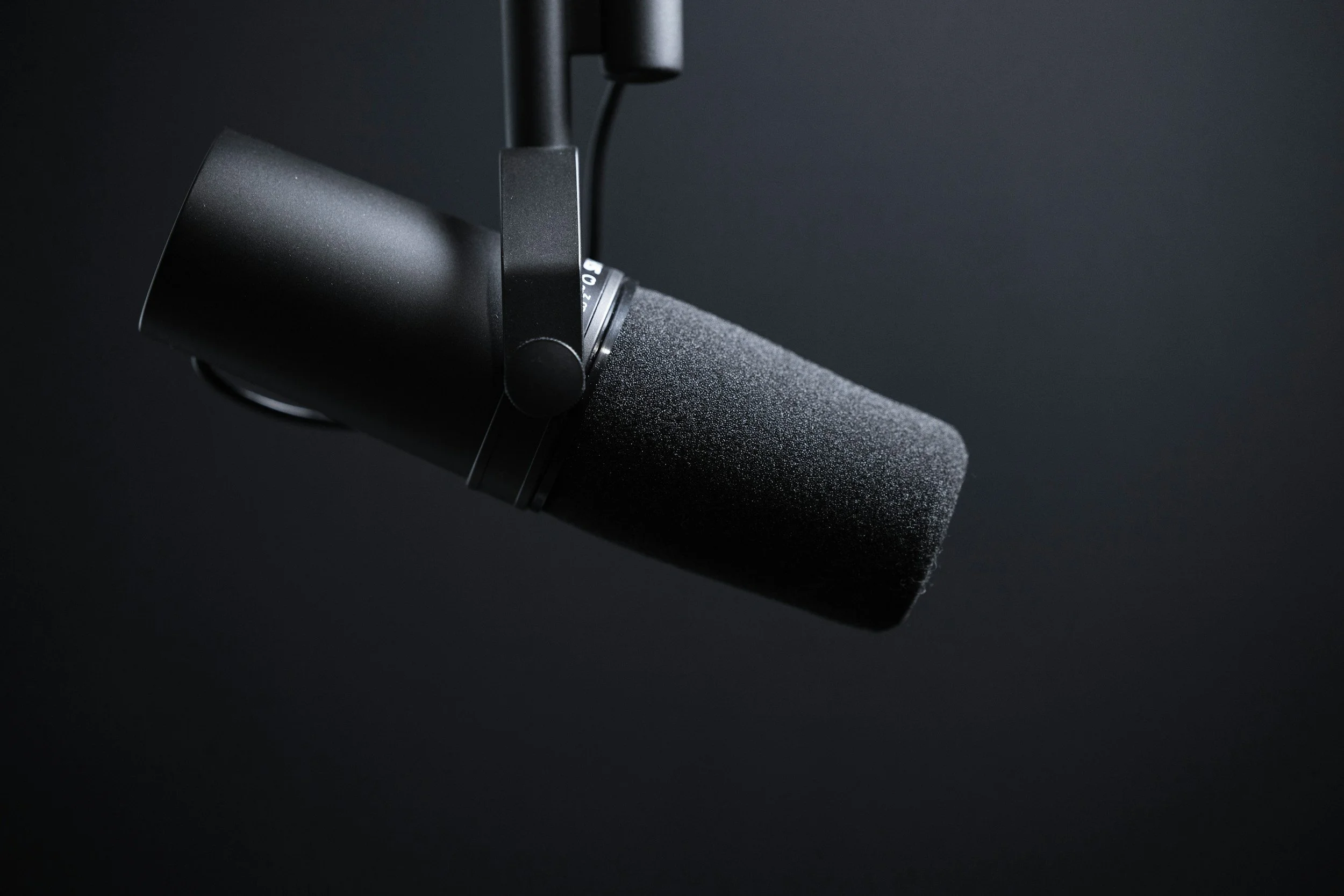
The Motivate Collective Podcast 100th Episode
Transcript
speaker-0 (00:01.336)
Hello, we have video. Welcome to our live recording. We're going to look at the people, not the camera. This is our live recording of the hundredth episode of the Motivate Collective podcast, something I never expected to say. Welcome to the first anniversary of the show. I can tell you now, this show started.
for most of the past year as a half decade old MacBook and a cheap microphone, but what it did become is people, partly all of these people over here. Sorry for waving arms around. And also we had guests from around the world. We included people in media and medical experts, you name it, in Europe, America, and I'm telling you now, you can make this as well. If I can do it, you can.
Whether you've ever thought of having your own podcast for your business or for yourself, whether you considered talking on a podcast once and getting the courage, it's mad fun. You can talk with anyone from anywhere. Right now we're talking here. So I want to ask everybody what it has been like to talk on a podcast. Ron turn. Your turn first.
speaker-1 (01:15.982)
Okay, thank you. as Melanie introduced me, I am Baraka Chimrillo. I am a novelist predominantly. I am I was Ed's radio personality. I write short stories, novel, but poems and I'm I'm the most animal I hold my
speaker-2 (01:40.285)
that's great.
speaker-1 (01:40.886)
Teaching courses in Mossman and Harry Hartford. I have my literary evenings, the poetry evenings, so everyone is welcome to Sanji Vend. And yes, Melanie interviewed me recently, like what a couple of months ago. I have been interviewed many times on various podcasts in various languages. so freely can say that all over the world for radio.
for television as well and well it's beneficial for everyone who has any kind of business it's very beneficial people they get to know you and you know who you are what are your skills and I'm educator and I'm always happy to advertise myself as an educator.
speaker-0 (02:22.655)
Show
speaker-1 (02:41.454)
Show who you are. Show your knowledge. Show who you are, what you know and how you can contribute to the community. It's all about that actually. Community or wider society. Depends where do you make
speaker-0 (02:54.806)
That's
speaker-0 (02:59.47)
Absolutely, show your real self. We were talking about art, but we also talked about death, all sorts of things. We got real.
speaker-1 (03:07.222)
yeah, yeah. And in other life through yoga we talked as well about consciousness and development of consciousness and the various really topics we covered. So anyone who wants to watch it is
speaker-2 (03:21.514)
Mel.
speaker-0 (03:22.254)
Yes. Yes. You can find all of us on Spotify, Apple Podcasts, whatever you're into. Next, we're ready to pass over to Dr. Eugen. Have you talked on other podcasts before this one?
speaker-2 (03:34.776)
Thank you.
I certainly have happy. Yes, yes. I think that one thing people can be guaranteed of this information age is that if you are on social media and you are not just speaking shit out your ass, then you are going to be invited on those button. And that is exactly what has happened to me. My name's Doctor Jen. And why would I call myself Doctor Jen if I'm not actually a doctor at the moment, which I am not? Well, I was one for nearly thirty years. It's very
Hard to take the doctor around with a brain. So I decided that the ideal client for me as a life coach, which is basically what I am now because that was a lot dog me out of the further use of medicine bottoming into, is a I helped women who have been in caring roles, who just feel like they're at the end of the teller, and whenever they ask for help, they just do not get it from the sickness industry. Now, why might that?
Well, I'm sure that many of you just likely have been to a health professional thinking that they were going to give you all the answers that you want. But of course, what do they give you? Six minutes. That'll be a hundred bucks, thank you. And maybe you'll get a Medicare rebate if you're lucky. So in Australia, we think we're really, really privileged because we have this amazing system for Medicare. But the truth is it's designed to keep you in a loop where you
Keep going back and thinking of everyone managing and getting help, but the reality is unless you put the work in yourselves, you're winning. So when I went on podcasts, what I did was I told my story. And what happened when I would tell my story, she's I would start crying like a baby because I had all of this got emotion inside me that I hadn't actually sorted. But once I really did the work, money fine, I could just pull it back and use. I love going on podcasts, it's a good business, yeah. I get to
speaker-2 (05:38.448)
to get to tell my story and I get to tell the truth. And I like to talk. I'd love to talk to many of you tonight who feel like you would want to know the inside soon. And I'm because yeah, I've had my mind a reader and I'm happy to chat.
speaker-0 (05:52.494)
Absolutely a GP with a margarita, former GP with a margarita. Sarah, you have recorded with me twice. And with Australian Wi-Fi levels in mind, I can tell you you don't need a steady Wi-Fi or a fancy camera or anything to record from the show. But what was it like? Had you recorded on any podcast before this one?
speaker-3 (05:52.83)
Yeah.
speaker-3 (06:16.204)
Yeah.
But I guess for me, I saw it as practice, right? So if you don't public speak in your daily job or you don't do it quite regularly, then I feel like being a guest on a podcast just gives you the ability to kind of practice speaking in front of the camera, speaking to somebody else to kind of gain that confidence in yourself to know that you know you can actually do it, you can give it a go. And again, like it's it's really low risk, right? So you know, if you're doing it one on one in front of a camera, like we
Are now then yeah, it really just gives you the ability to kind of build up your skill set, build up your confidence, and just have a go. because like literally, when I first started public speaking, I was absolutely terrible. I was absolutely like super scared, and the first time I ever did it, it was the worst like time of my life, but I just kept doing it right. So the more you speak, the more you you know prepare, present, the better you get at something. So yeah, if I could give anyone advice.
is just to you know give it a go. it can't be as bad as what I was originally, surely. but we all have to start somewhere, right? So I guess being a guest on a podcast just yeah it gives you that ability to to practice presenting, practice speaking, and then yeah just watching yourself back over and you know seeing where you could you know better your better your skills. So I guess that's what I really got out of being on a podcast at this stage of my life and yeah I hope to be on plenty other podcasts. So
speaker-0 (07:46.414)
Absolutely. Robbie Robbie was the one time I used a studio and it was the cheapest studio I could find. But that was an experience. I talked on Robbie's podcast, but it will be out eventually. I got so honest on Robbie's podcast, I wondered will someone's lawyer be pissed off that I just don't care anymore. Seriously, but for ours. Robbie, you went from talking
Talking about training to then explaining your one-way ticket to Sydney. I mean, you really explained your journey and you had all these sound bites like what was it, nobody wants a fat trainer or something like that. All of you had all these lines just in a conversation that could have been back in the day you'd say it's a tweetable. I mean, what was it like for you to record it had you done it before?
speaker-4 (08:41.76)
I I have done it before. just with you was a real, real professional one like one on one in person on an actual podcaster. So that was good. and I think right now people what they like is having a contrarian linking where you you think and you say something that people might disagree with and that's what normally gets used. That's what I found. And with six
Me really well because I tend to be very revolutionary on everything. So I've been told that apparently AI can't work well with fitness because apparently AI can't take over PT, which I agree with, but how about you can automate all the rest at the back end so you can actually have more human connections, and that's my goal. So helping people like me who obviously have two studios and plenty of employees who have face-to-face with people, and so we can
and you know automate all the rest at the back end so you don't have to drawn into your admin stuff and you can just continuously to talk to your people to your to your clients go get a coffee with your friends and and jump on amazing podcast like Melanie
speaker-0 (09:59.63)
Absolutely. Robin, you mentioned the efficiencies. In three sentences or a half a minute, how did you save time to free yourself to have more conversations?
speaker-4 (10:13.72)
Two things. Number one, I always think AI first when I need to hire. So if I need someone to take over or something to be able to take over of certain tasks in the businesses, first I think if AI can do that particular thing and then the rest that can't be done by AI, I will hire somebody that can be trained with AI so they can work with AI. So there is no need for people to be replaced, but I can train people on using AI so they don't get replaced.
If that makes sense. So it's no longer AI taking over our sports, but it's actually using AI as an advantage just so you have a new skill. You know, when we go to university we think that we can learn a skill, we can get a certificate that debt will help us to get a job, but actually if now learn AI, we can actually learn a new skill which means you more.
Skilled and and so you can help more people. And that's how I think and that's probably the best way to do it.
speaker-0 (11:17.262)
You want to hear more about that? We have live sessions available. Robbie agrees anytime I ask to teach people online wherever you are, so you can learn how to use technology to get more freedom to connect with humans. How are we doing for a time? Eleven minutes. We have time for one more question. Questions. Does anyone have a question about knowing the panelists? Any questions about
Podcast about standing up for your health, about getting your confidence. There's a question at the back. Dive in. you need a mic. Do we want my mic or there, Mike?
speaker-2 (11:58.202)
But I think
speaker-3 (12:00.834)
Jebra, you just g spake up like
speaker-0 (12:04.13)
Dive in. Woohoo! my name is Elliot and I'm a freelance copywriter. I do apologize. I don't I think we can make what's the name? So obviously with everything sort of years, radio, television, the internet, social media, what do you find happening?
speaker-2 (12:10.878)
Thank you.
speaker-2 (12:18.776)
Changing in the last twenty
speaker-2 (12:26.842)
Has changed more so in terms of communicating to an audience based on
speaker-0 (12:34.315)
Yeah.
speaker-2 (12:40.366)
What did that explain has changed?
speaker-0 (12:45.078)
Everything has changed in terms of how we use the page. So you know, people aren't necessarily reading use pages. Yeah, yeah. Going offline, radio, you only really listen to in the car, you know, switching on the room. Listen to a couple of Obviously, doing a live podcast here, that's a very different way to talk back radio. What do you think?
speaker-2 (12:55.896)
Yeah.
speaker-1 (13:05.438)
But well, as you say, everything has changed. It it was a revolution in, you know, media.
Because before we had media houses outlets and as you say, like we were reading more every morning newspapers or listening to the news. So now we have all these, you know, podcasters, people as well that are educated and that that they are not. So you know, you got a lot of variety now with people that are really good in what they are doing or what they are learning how to
do all the way down to the people who don't know really what they are doing. If you you know so it has changed a lot and look I don't know what to say with especially you know like that white side of it that you get to be very careful because there are a lot of people out there with misinformation a lot of people so so-called
conspiracy theorist or you know so one has to be watchful what's what one is listening to. You know, I don't say anymore even that mainstream media is the most reliable source of information. But yeah, on the positive side, like Melanie or you know the podcasters that I was in
dealing with I had very positive experiences. There are people who do good research, who ask right questions, and their podcasts they grow. They again as I go from the angle of education, they educate people and you know, there is much more access to information, all sorts of information. And so I see it, you know, as in anything positive and not so positive.
speaker-1 (15:09.858)
But you know, like one needs to discern what's what works for one and what what's you know discernment. Yeah, absolutely.
speaker-4 (15:17.954)
To say
speaker-0 (15:20.332)
This raises a question that all of you can answer because beyond being an expert in something, Brunka, I was even bringing to you the question of which sensitive topics we're going too far and people don't realise when you're running a podcast or doing any content, can tell you any trauma, disaster, or anything you can think of, people have said it on the podcast. And it gets pretty extreme for me to not publish.
I mean I'll publish almost anything, but there's a limit somewhere. And you'll hold space for people, whether it's I feel self-conscious about my body and I want to lose weight, whether it's I want to go to community and feel nervous. Dr. Jen, you're dealing with holding space in all sorts of ways. So whether you're talking with someone in a holding space capacity, you're figuring out
What can I say? The holding space, that's crucial as well, right? What do you all say to as everybody can publish at any second, what advice do you all have for everybody who's publishing in some form at every moment?
speaker-1 (16:28.958)
Yeah, yeah, like you know we we had before so called gatekeepers, you know, in publishing industry, so you couldn't publish anything, whatever you wanted. So it it was really publishers try to find something that is of of the best quality, you know, to offer to readers to but you know nowadays as you said, we can publish everyone can publish. So which is you know raises the problem again that
speaker-2 (17:01.078)
Yep. Yeah. I I think that the definition of information is that it is always going to be biased. So you have the bias of your own filter and you will attract what is attractive to you. And you do not need to artificially
speaker-1 (17:21.102)
Okay.
speaker-2 (17:24.481)
use a filter that is going to be like for example, you know, thinking that mainstream media needs to keep us safe by withholding certain parts of information. And so I feel that now that as I said
We are in the instant information age, where basically you will get the filter of the you know, the search engines or the AI or whatever filter that you put it through. Everything is biased. So recognize that and be a critical thinker so that you recognize your own biases and be attracted to what attracts you. And don't be afraid of that, because if you connect in with what your body's intuition is telling you about things.
then you will actually be the biggest expert on youth. Yeah, that's what I me you know, the expert is there has been a drip under pressure. So you don't want to be an expert. You just want to know yourself and be true to yourself and go through life seeking information with that kind of vulnerability to yourself. And even
speaker-1 (18:31.32)
Teach yourself.
speaker-3 (18:32.494)
I think my perspective on that is yeah like especially in the age of AI, right? Everybody can go online now and find information. It's so easy to do so. So you gotta think about what is then I guess the purpose of you know of us as humans, right? So everyone's had a different experience, everyone's had you know, different things happen to them in their lives. So I guess I kind of see that like, you know, relationship human connection part as being that like
actual experience part, right? Because, you know, I guess AI can give you all the information in the world. It may not be right, it might be biased, but it's not until you actually speak to a human and you you work out what their experience has been or what advice they're giving you do you actually realize whether the information you've been given is accurate or not, right? So I feel like, you know, being on a podcast just allows you to kind of connect to more people as a human and you know, create those relationships. And yeah, I feel like
You know, AI's here to stay. There's so much going on. It's you know, basically changing every industry, right? But it's really just remembering what the purpose of of you know human connection is and yeah, what we're all about. So
speaker-0 (19:45.494)
And Robbie, how did you go with the vulnerability of recording and also the vulnerability of people going to you and saying, I want to change? I how do they feel? Do they feel nervous or excited? Where does that all land?
speaker-3 (19:53.494)
Right in
speaker-4 (20:00.118)
I found that people don't like change. People actually don't. so if you propose something that is different from what they've been doing all their life, or what they believe or what their expectations are, you're gonna disrupt something. And this is what's disrupting a lot of people when we talk about AI, right? Cause we we were not used to it. And so people are some people are more inclined to the change, some people are not. I would say most people aren't.
so that's that's basically the thing. Like we are the byproduct of all the amount of experiences that we had in life. So mostly of the trauma of when we were kids or when we are teenagers. So when you go to a podcast, I always feel like this is why I love it, it's because I feel like I can express myself without any filter. And and actually I found out that people love that. And once you gave your
perspective there are there will always be people who will criticize you for for that and they will stop listening to you but it will attract the people that can resonate with what you said.
speaker-0 (21:08.034)
Absolutely. We have explored a lot. Going Okay, we're all good. Maybe a little bit of distance. Okay. Distance from the camera. That's awesome. What about Yes, wait, so we want to eat some okay. One more question.
speaker-2 (21:22.488)
We
speaker-3 (21:27.086)
Yeah, yeah.
speaker-0 (21:29.62)
Okay, let's grab a question. Let's make it conversational. are the mics dead? Yeah, I think so. The mics are dead. Okay, we have one in the middle. So Louisa is going to bring the phone right in front of you and we're going to have a conversation for little bit. What's your question?
speaker-4 (21:47.502)
Hi, my name's Ken and I I my business is I I source or help businesses save costs by sourcing products locally made. But my question probably to Sarah or maybe to everybody here, I find that the reason why it's for Sarah is because I find when when I talk about money, for example, socially or professionally, people some t a lot of time immediately think that the greed of money
I think the relationship that people have with money, how do you deal with that, being a financial expert? How do you deal with that?
speaker-0 (22:25.08)
Yeah.
speaker-3 (22:25.944)
So how do I deal with people's relationships?
speaker-2 (22:28.878)
with money money.
speaker-4 (22:29.73)
Correct, really because when when you a financial
speaker-2 (22:33.634)
Finals.
speaker-3 (22:34.458)
Yes, yeah, yeah. Well I guess it comes back to just spending time understanding that person and asking the right questions, right? So the better quality questions you have, the more you can identify what that person's mindset is and then what their belief system is about money, the role that money plays like in their life and ultimately therefore, you know, what they're looking to achieve, right? So, from my experience everyone's kind of different. every
Like I used to help a lot of couples, every couple's different. So you kind of can't have a one size fits all, right?
I feel like at the moment though in Australia we've got a huge cultural problem, right? because we've gone from a a system of entrepreneurship, giving things a go, aspiration, wealth creation, building you know, society to now penalising anyone who wants to basically do anything. And I feel like that's a huge problem, right? and it's I feel like it's a bigger problem for that next generation who are now being told that, you know, it's all you're all greedy or money's a problem or
Or, you know, this this this is this is and it's really sad, like you know, as as a local to Australia, you know, my family's been here for generations and to see the you know the culture of the country now just kind of become so toxic, you know, those discussions.
speaker-0 (23:55.214)
Both of you have talked on the podcast about the talk poppy syndrome in different
speaker-3 (23:59.73)
That's a big part of it, right? Like we just think somebody does really well now. It's just it's it's you know, for some reason people think it's okay to pull them down rather than celebrating them and saying, Hey, what have you done differently that, you know, maybe I could do or how can you kind of inspire me to be better? It's like, let's pull them down to my level. it's a culture issue that we've got. you know, and yeah.
speaker-0 (24:21.962)
Hey C.
speaker-4 (24:22.418)
To to pull people down rather than than you trying to get up at the same level. So I would see an inspiration, somebody that makes a lot more than what I do, right? And pulling it down and trying to say, Hey, can you teach me actually what you've been doing? Because at least I can replicate that. But that's unfortunately the case, especially living in the same, like working in the same network with other people in the same brand I talked about. normally people who are behind you tend to pull you down.
talk talk shit like you because it's easier. Yeah. Similar to the thing the people who who say and talk about work life balance, typically they are average or mediocre. Yes.
speaker-2 (25:04.738)
Yeah.
speaker-1 (25:07.117)
Yeah.
speaker-0 (25:07.822)
Thanks to wind up on that aspirational note. Yeah. Okay, remembering where the camera is, you want to listen, not more. Thank you for listening to this episode, to any episodes, and thanks to all of you for I'm getting done.
speaker-1 (25:28.334)
Yeah.
speaker-2 (25:29.238)
It's gonna be
speaker-0 (25:29.454)
You wanna be on your podcast. absolutely the CTA. Okay, CTA time. Little bit of distance. Okay, no, the camera is up close, I'll get over it. CTA time, everybody, first of all, I'm
I normally just talk remotely. I've recorded remotely for all except one. Okay, CTA is everybody. If you want to hear about what any of these lovely people do, then find info on the website. If they want more links, they can send it to me and I'll chuck more links on. Quite frankly, if you want to connect with someone who has done any medical specialty, if you need a neuroscientist, if you know, if you need a journalist from America, almost anything, just let me know they've been on the bloody podcast.
I swear. I'm not an expert in anything, I just talk to them. But also, if you want to be on the podcast, queue up slowly and virtually, I'll send you a link. Make your own podcast. Get your own. We'll teach you how to do it. Thank you so much for being here to time this party.
speaker-3 (26:33.102)
And so you had to put me here until I dynamic
speaker-0 (26:35.662)
So I can explain the DJ.