
The Business Currency of Generosity | Suela Pirushi on Trust, Relationships, and Building a Global Impact
What if the most powerful currency in business isn't money — it's generosity?
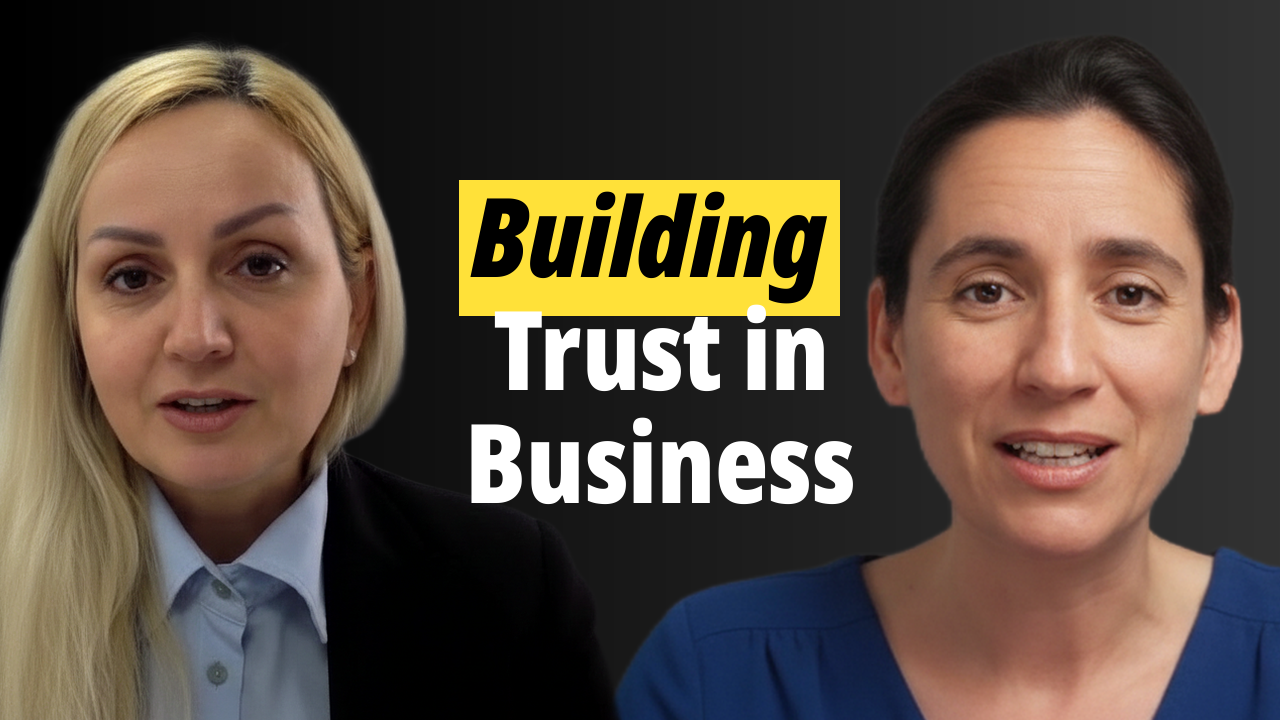
In this conversation, Melanie sits down with Suela Pirushi, Albanian-born founder and CEO of the Milestone Hub, author of The Business Currency is Love, UN Women UK Ambassador, and PhD candidate in Epistemic Leadership and Human-AI Collaboration. Suela has worked across the World Bank, the Ministry of Justice, NGO management, and a decade in B2B commercial partnerships in the UK — and through all of it, one truth has remained constant: business is fundamentally human.
Listen to the entire episode on Spotify, Apple Podcasts, or most major podcast platforms.
Show Notes
What we explore in this episode:
Suela opens by sharing her remarkable journey from post-communist Albania to the UK, living and studying across Bulgaria, Germany, Italy, and beyond — a life of never quite fitting in that ultimately shaped her as an expert in cultural nuance and cross-border relationship building.
She introduces her philosophy that every successful business must invest in trust, relationships, and generosity — giving before gaining. It's not just a nice idea; she traces how these principles have played out across corporate roles, World Bank projects, NGO leadership, and now her own consultancy.
The conversation turns to AI and the fear many professionals feel about what it means for their futures. Suela reframes it entirely: AI frees us up for the things that matter most — human connection, partnership, and trust. As someone writing a PhD on human-AI collaboration, she speaks with rare authority on both the opportunity and the responsibility.
They also discuss the power of storytelling over statistics in business; why legacy matters more than ROI metrics; how to start a business from scratch using only your existing skills; the importance of going global rather than staying local; and how to navigate authentic online presence without oversharing.
Suela closes with three lessons every business owner needs to carry: give before you gain, build relationships — not transactions, and always see the human being in front of you.
Guest Bio:
Suela Pirushi is the founder and CEO of the Milestone Hub, a consultancy and coaching company helping small businesses and solopreneurs convert their expertise into revenue. She is the author of The Business Currency is Love, available on Amazon, and holds three master's degrees alongside an in-progress PhD in Epistemic Leadership and Human-AI Collaboration. Suela is an Ambassador for UN Women UK and volunteers for two UK charities — one supporting women experiencing violence, the other helping young women and girls from Albanian origins access STEM education. She is based in Buckinghamshire, UK.
My website: www.themilestonehub.com
The book:
Amazon Australia
Amazon UK
Amazon US
Connect with Suela: Find her book The Business Currency is Love on Amazon.
🎙️ Listen now via your favourite podcast platform — links below.
🌿 Join The Motivate Collective community for more conversations, events, and resources built around growth, wellness, and conscious living: www.motivatecollective.com
Get your membership now.
Transcript
Melanie Suzanne Wilson (00:00)
So hello, welcome to the Motivate Collective podcast.
Suela Pirushi (00:03)
Thank you, Melanie, for inviting me.
Melanie Suzanne Wilson (00:05)
For those who don't know, how do you explain exactly what you do? You have quite a specialty.
Suela Pirushi (00:13)
Yes, I am an Albanian-born citizen. I live in the UK for the past 12 years. I have been studying in different European universities, living in different countries and now settling down in the UK. More specifically, background comes in different professional settings.
I used to work with projects from the World Bank, then in the Ministry of Justice, coming to the management of an NGO. And for the past decade, I was working in a B2B commercial setting within the UK. Right now, I am the founder and the CEO of the Milestone Hub, a consultancy and coaching company, where I help small businesses and solopreneurs convert their expertise into revenue. As well, I'm the author of a book, the business currency is love, which everyone interested might find on Amazon, and here I am today in front of you and your audience.
Melanie Suzanne Wilson (01:26)
Wonderful.
You also have told me you're doing something with the UN. What's happening? Sorry, what's that involving?
Suela Pirushi (01:36)
Yes, I do volunteer a lot. I volunteer for two charities, local charities within the UK. One is helping women fight violence. The other one is Academy Achievers, which helps young women and girls from the origin to access STEM education.
I am an ambassador of the UN Women UK, and I'm highly involved in women's rights and
Melanie Suzanne Wilson (02:17)
Amazing
Amazing. You mentioned that you consult small businesses. What do you believe every small business needs to know and needs to start doing?
Suela Pirushi (02:23)
Thanks.
What it needs from... okay, I'll tell you my philosophy and proven framework. According to my opinion, every successful business should invest in relationships because this is where the secret lies. Throughout my working experience, I have seen in different countries how people build trust. And by the end, ⁓ we figure out that the thing which keeps the business running is human-to-human interaction. And right now in these days, we live in an era where AI is coming into our lives. By the way, here I mentioning that I'm just finishing a PhD in Epistemic Leadership human AI collaboration. And I find it fascinating how the new leaders, I call them the modern leaders, use AI into their daily business in order to get more work done, but as well not sound generic. There are different issues or problems being discussed in those circles that people are afraid of AI will get to replace us. According to my opinion, this is not true. AI is here to help us, just to free up our time and let us be focused on the things which are more important, like relationship building, partnership building and everything in a business that's with trust. Let's take you for a moment. You cannot enter into a business relationship with someone whom you don't trust, right?
So, trust is the basis of...
Melanie Suzanne Wilson (04:29)
We need to build more trust. Are you seeing that as AI is growing in the world, there's an opportunity for everybody to amplify the things that make us more human?
Suela Pirushi (04:43)
Exactly. It is something which can never be replaced. Human-to-human interaction.
Melanie Suzanne Wilson (04:51)
Are you seeing a parallel there between your business relationships and your volunteering? Is it all a matter of simply connecting with human beings and seeing how you can be helpful?
Suela Pirushi (05:05)
Exactly. I believe that every relationship starts from a place of generosity; you give before you gain. This is my philosophy in life and how I built everything in every setting. I have worked in different countries, in different cultures, and something which is unchangeable but labelled in different words throughout the world is trust, relationship building and generosity. Give to gain. By the way, this was even the logo for this year's UN Women Month in March. So we are first of April today, yes, last month. Give to gain. We have to give in order to gain.
Melanie Suzanne Wilson (05:57)
Give to get.
What does generosity look like in everyday neighbourhoods?
Suela Pirushi (06:05)
In everyday neighborhoods is looking and taking care of the person who is in front of you, seeing them, him or her as a human being. In a business setting, is not taking your business partner as a transaction, right? Before in every meeting, even corporate roles, no one will remember the numbers you will put down. Yes, they will take note.
Yes, they will read the contract, but whatever stays with them is the story you put behind those numbers. Let me say an example. If you say through our project, we managed to achieve 40 % of profit, they will forget in five minutes after the meeting. But if you say through our project we invested this money and changed the life of these many families and you put a story behind it.
First, the number will be stuck in their memory, and second, you will even see the joy or the happiness or the emotion, this statement, the same thing, the same numbers, but just transmit different things.
Melanie Suzanne Wilson (07:21)
Absolutely. Let's have a look back in time, and I'm curious to know what inspired you to get involved in all of this? What led you to do this work?
Suela Pirushi (07:35)
Well, I've been brought up from two parents, my late father, which was a lead example for me and my mom. My mom always was a lady doing a bit of work, more family focused. And my father always pushed us in order to achieve our best, which I am extremely thankful to him. I was first born sibling. I have another sister and a brother.
And all the tensions growing up, mostly in our families, go to the firstborn. They require more, they push harder. My mom has Bulgarian origin and I was brought up in a family when I used to speak two languages. And this is the reason why I want in my youth time to study in Bulgaria.
And being brought up in that way, my father, I was five years old. I couldn't even write and read in Albania, but I was attending Italian language lessons for more than 10 years. I have studied Italian because my father was very attached and emotional towards this culture. I know more for the Italian history in literature rather than Albanian. In a good way, I'm telling this, not in a bad way.
And so I was brought up in an international setting in a way, and always not fitting in. In Albania, I was always looked like the Bulgarian one, in Bulgaria, I was looked like the Albanian one, and I got used to it. Then throughout my studies, my years in Bulgaria as a student, I moved to live in Germany with my uncle for around a year. I got introduced to a more Western country rather than a more Southeastern culture. I saw a different approach, same principles, but in a different setting. Then I came back home after finishing my, I have three master's degrees. After finishing all of my studies, I returned home trying to build a family and to invest in my own country. And again, wasn't right. And then I became a mother, I said, I want to try, I want to see, I want the best for my daughter. I came from a post-communist country, and the country was trying to build up, but nothing was working. And I came to the UK, I was introduced to a company, I applied for the role, I got the place and I worked with them for 11 years in business management, development, partnership building, even here in the UK though the company was UK based but we were dealing with more and more and more on a daily basis with international clients and those cultural colors I called them helped me identify that after beyond each phase there was a human being so made me an expert in knowing on how to approach Melanie or how to approach a German client how to approach a Bulgarian client. And this made me aware that is a pattern recognition and every human being evaluates and relies on what you give to them, how much importance and how much involved you are as a person to them. This has never lied to me.
I have tested this in different settings, in different countries and in different working environments, from corporate roles to managing projects from the World Bank to managing an NGO, trust, relationship building, and partnership building. Thanks.
Melanie Suzanne Wilson (11:31)
That's what it's all about. This is quite a journey. I'm keen to ask you about your views on the current global trends. Of course, a lot is changing right now. And without delving into the politics so much, people are feeling anxious. People need an opportunity to have courage and confidence in their professional lives.
Suela Pirushi (11:51)
Thank
Melanie Suzanne Wilson (11:59)
When there seems to be some uncertainty right now, what words of wisdom do you have to professionals who need that confidence as we wonder what's going to happen next?
Suela Pirushi (12:13)
What is going to happen next? I might disappoint you. I cannot tell you, and I cannot predict the future. I hope and pray only good things will happen for as long as we don't have access to decision-making in the global and in the biggest context. I might say that our duty as the citizens of the world is each one of us to do their best to treat the other as they would like to be treated.
And this is it, never lose hope. Things would go beyond our responsibility and decision taking. We cannot make any changes right now, but we can let them hear our voices and do and help as much as we can. If I have time, I will contribute and volunteer in the countries where now crisis is happening. If I have money but I don't have time I will contribute through a donation. So we have different ways in contributing and helping others. Someone which is extremely smart and knows how to do business let them do more business but give from their share to others who can do the logistics.
So there are different ways and willing, important is to have the willingness to help. I do this in my own life as well. And sometimes it's not like only donation and contribution or personal involvement. Sometimes it's being there and listen to them. Sometimes it's finding and connecting the right people with different projects, let's say the town where I live in the UK, in Buckinghamshire. The council has different projects and helps people who come within the country to help them reintegrate themselves and have a better living. connecting the right people with the right projects and the right cause. I feel sorry for what is happening around us. I'm not happy at all. If I had the magic wand, I wouldn't put peace for all of the world can't do that. I don't like to get involved in politics. It's not my expertise. But whatever I may take to each individual, wherever they are seated, take the action. Things start to change with the decision you make today. I have placed myself always throughout my life through different settings, difficult decisions.
And the one thing which helped me to overcome every problem was the moment I took the decision to change.
Melanie Suzanne Wilson (15:13)
Absolutely. The counter-cultural advice here that people don't always automatically go to is that we can face these current trends by helping other people, and that will then bring more abundance to us. I don't take that perspective for granted. Where I live, people are just thinking about the fuel, the petrol, the gas, whatever you call it, all they are thinking about. But what you are reminding us of is that what…
Suela Pirushi (15:48)
There are people, yes there are people over there that cannot put even food on their table so we have to think about them as well and do as much as we can even go beyond of them because we as humans we say I did my own best no if you have to do your own best you can do more there are millionaires over there in the world let's say I don't want to mention names and you call it as a publicity but there are people who feed other people and billions and millions meals a month. So, each one, if you put food on your own table today, think about someone who cannot eat. Try to get leave from an expensive coat or an expensive bag. Don't buy that bag. Go and give that money to a charity. You will feel happier. Trust me. The bag is just like something which makes you happy for the five minutes, but those investments of your five minutes in a bank change lives.
Melanie Suzanne Wilson (16:49)
Really does, and this can be done locally as well as helping people overseas. There are so many local issues and trends leading people to need more. Definitely.
Suela Pirushi (17:01)
Exactly. Exactly.
Melanie Suzanne Wilson (17:06)
Beyond helping everybody else. If someone is trying to build up a business, here's a question. If someone is trying to build up a business from scratch right now, AI is becoming more of a trend, and we know that we need to build a personal brand. It sounds like networking is a part of the solution to get a business off the ground.
Suela Pirushi (17:18)
Mm-hmm.
Melanie Suzanne Wilson (17:34)
What do you recommend within networking and anything else if someone is starting from the beginning?
Suela Pirushi (17:40)
If someone is starting from the beginning, the question I get most is, I don't know what to do. And I start with a clarity framework. said, okay, tell me what are your skills, background, education background. I have helped even people who are not with a degree. And now the new generation that you have seen more millionaires and billionaires in right 18s or 20s through the use
AI. I'm not telling that people shouldn't study, don't get me wrong, but I'm telling you that each one of us as human beings we have certain skills. Even if you have an education, you can make money; even if you are uneducated, meaning without a degree, you can still make money. Find out what are you good at. I had case prior to this to a woman who wanted to be self-sufficient but she had no degree she had nothing and came to me and told me i want to make money but i don't know to do anything I made her ask questions and at the end i said okay what do you do in your free time or you enjoy doing she said cooking now i said okay let us do cooking lessons and you upload your videos on youtube and if you are good enough you will get through the algorithm and you will have followers so you monetize your skills and she said but there is a big problem i don't want to show my face now with the age of ai you can do faceless marketing i'm telling you for anyone over there if they have a skill a passion even if they don't know don't have a skill they can start a book club online so people will attract the same people community will build community so whomever your voice or your message resonates with, find the ways now in a business setting, yes with the change of AI, people are getting scared, or AI will do this, making no AI is here to help you to do a job if prior to that, you would have opened the consultancy practice and set up documents and things like that. It will take ages right now. It takes a shorter amount of time, leaving you the ride and the possibility to focus on your Mission in helping and building up things from scratch. Brand is extremely important if we go and look at the global brands. Let's say, if someone asks you, tell me about a frizzy drink. You will always think of Coca-Cola, so if someone has to be successful in their business, they have to start to build a brand. The other thing rather than brand is as you mentioned networking is the engine which makes you grow nowadays. Marketing in the last decade has changed so much and is keeping changing so we are barely trying to keep pace with it.
It was the general marketing as we did it long back, until then we moved to the digital marketing with the entry of AI, everything changed. Now we are used to learning and to cope with algorithms. As technology evolves, it should be even for us able and capable to navigate trends.
Melanie Suzanne Wilson (20:56)
The way to do everything has changed. It has. And the cooking example is perfect. I must admit, I talked myself out of doing cooking videos a few years ago, and I thought about it, but didn't. And what we need to know now is that it doesn't have to be perfect. You suggested AI, but even someone can film the food and then talk about it in a voiceover, so they don't have to appear on the screen.
Suela Pirushi (21:26)
Yeah.
Exactly and in different settings we are used to do gym to go to the gym because it's more discipline more interacting with the instructor and the co-other people who train with us but now you can do gym even from work you follow up a channel they have challenges three minutes seven minutes a day 15 minutes up to your timing and so you have the gym instructor right now over your phone…
How? This is a business idea for those who want to implement their skills as trainers. It's not only everything related to education. Yes, education is important to help you to navigate the trends, but as well as opening doors, but you can monetize your skills even without having a degree in the age of AI.
Melanie Suzanne Wilson (22:38)
Definitely. Have you looked into selling to audiences in multiple countries overseas, anything like that?
Suela Pirushi (22:47)
selling what my expertise, my business idea, consultancy. Yes, yes, I have been doing this for the past decade in the company I used to work for. And right now I am dealing with people and clients in different audiences, in different countries, the USA, Europe, the UK as well.
Melanie Suzanne Wilson (22:50)
anything.
Have you seen that it's important and perhaps necessary these days to sell your brand and your knowledge to overseas audiences and to not just focus on your local markets?
Suela Pirushi (23:21)
Prior to me entering this podcast call with you, I was talking to a very lovely woman from Singapore, and we connected on LinkedIn. Now the world is such a small place and you can reach continents. Importantly, I'd just like to schedule a little time because when time, a day is here to me, it might be night overseas, but yes.
Right now, with the use of the internet and technology, you can reach even the most distant points in the world. Yes, I work with different audiences throughout the globe, not only UK-based.
Melanie Suzanne Wilson (24:03)
It's easy enough to not let the time zones get in the way. For me, it's after 6 pm. What time is it for you now?
Suela Pirushi (24:10)
Yes.
Right now here is 8.30 in the morning. But I am... Yes, I wake up early in the morning, so to me this is quite a normal working setting. And I don't know, different people have different routines. I'm an early morning person, and I sleep for very few hours. So I have my morning routines, which is uncompromised and this is it. To me it's not a problem in timings.
Melanie Suzanne Wilson (24:19)
See it.
It's fine, it's fine. And really, I've seen similar patterns where I chat with people in America, different locations, and the time zone isn't an issue. The main thing is to be aware of any changes. I saw that a few places had daylight savings, and then suddenly the conversion is different. So we have to be aware, but it's not, it's not complicated and it's not a barrier.
Suela Pirushi (25:09)
No, at all, at all, at all. And you can find people with whom you resonate or with whom you can work and partner throughout our love and love. It's easier. The Internet now has the marketplace wherever you want to find it.
Melanie Suzanne Wilson (25:26)
Are you saying that you can find more like-minded people and people who think like you somewhere else?
Suela Pirushi (25:32)
Yes,
Yes, you can find it locally, close to you, and you can find it very far from you. So this is the power of the internet.
Melanie Suzanne Wilson (25:43)
We really do have a global village at this point, right?
Suela Pirushi (25:47)
Exactly, and this comes, turns us back to the statement we started. So technology and AI are not here to replace us. They are here just to connect us. And the most important thing is human-to-human interaction.
Melanie Suzanne Wilson (26:05)
Absolutely. I still want to be careful about some, some things that AI could do. I think about cyber security, things like that. There are issues to be aware of. We need to make sure that people have their privacy. However, every tool can be used for good or bad. Have you seen that whether it's social media, AI, or anything else, it's about what we do with it? Do you think so?
Suela Pirushi (26:27)
Good stuff. Peace.
Yes, yes, it is absolutely up to you on how you use it. You can use it for good purposes and not such a good ones. And it's up to you to access those things which have data privacy issues or not. And it's up to you on how much you are willing to share.
Melanie Suzanne Wilson (26:52)
Yes, we don't have to share everything. True.
Suela Pirushi (26:55)
So this is it.
Melanie Suzanne Wilson (26:57)
That leads to something else. When we're deciding how to present ourselves online, have you found that it's important to create a balance? You emphasise, for example, some of your volunteering, just looking a bit more balanced and showing some of your personality online beyond your main work? Was that a part of what draws you towards?
Suela Pirushi (27:05)
Mm-hmm.
Melanie Suzanne Wilson (27:26)
new audiences.
Suela Pirushi (27:28)
Me as a person, I'm very private one. I don't like sharing much of my own privacy and it shouldn't because things are work is work, business is business and private life is private life. So till now I have been, I was able to keep this balance in perfect harmony because if you put boundaries and you look after those, you will never have an issue. So it's up to you. It's a total human decision. I haven't seen a problem. I decide with, let's say, in the voluntary setting, as you mentioned, we decide on what to share from the personal. Sometimes we have to overshare with another woman or a person facing the same issues we have gone through because we leave them by example.
Sometimes we don't share because there is nothing there which resonates with them. So this is it, what I said. Saying the right things at the right moment, sharing whatever you feel comfortable with, but keeping the balance. Work is work, business is business, and private life is private life.
Melanie Suzanne Wilson (28:39)
The boundaries and the balance will change in different situations with different people. I'm curious, when you are trying to find some compassion and perhaps share a little bit for compassionate reasons, is there a way to do that, still looking professional? I asked because I'm finally being open in saying a week ago, I fainted and I realised I had to start implementing. No, I had to more strictly implement the self-care habits that I know are needed. I had to get back on track. But then for a while, I didn't tell the online world that I fainted. And there's a balance we have to figure out, okay, what do people need to know, but slowing down sometimes, you might see in the workplace, perhaps someone has a health issue, and they need some time off work, anything like that. I'm wondering
How do you navigate what can be shared and how people can maintain those boundaries when also pursuing some flexibility?
Suela Pirushi (29:46)
Well, I think this reminds me of a leadership principle throughout the history we are taught in looking at, let's say, let's get an example, Napoleon on church, the strong, the authoritative leader, and then things change. We pass into more like democratic leader, the leadership style, like the servant leader. Right now, we are in the age of, I call it, modern leader. What is this new modern leader? It ties back with my PhD human AI collaboration but the human is the focal point. Human to human will never change. And in regard to what you say, I don't consider this in a business setting, saying that I fainted last week as an oversharing. This makes you more authentic right? And people resonate with your story. You show to them, yes, you are a business woman, you are managing this platform, you are doing this, interviews, workshops, helping people, but you are as well a human being. You are not a machine. You cannot put on and off.
I don't consider this oversharing or going beyond boundaries. This is part of our daily lives. We cannot be happy and excited every day. We have our mood swings. It is important to keep this. Sometimes we have even our health issues. Yes, we should share. The priority is keeping good care of ourselves, our health, which is irreplaceable. The rest can be built up, even business, even reputation, even if you consider, at a certain moment, I overshared a bit more than I should, or my business partner will consider this as a weakness, or overshare is not something which can, in my opinion, damage you. Being kept at the normal settings, meaning you can say I don't feel good today because I have that issue related, but not like I went to the hospital blah blah blah in a business settings meanings are very important so no one has time to listen to your story sometimes you will resonate with people who are talking or love to hear you can overshare but mostly in the business settings saying the right sentence and if you a couple of those it's more than enough I think learned and seen in recent weeks that some people like a one-line answer. Have you seen as well that some people are very busy, and whether we're talking about something that's directly work-related or something adjacent, do you see that some people need a very brief answer when they have limited time?
Suela Pirushi (32:32)
I have seen this in different countries, and I think it's a cultural issue. When you enter into a business relationship, now I'm just giving you an example, in the UK we are sharp and determined. say, meaning we never say, you outperformed, or we say, you did. Well, this is the hugest compliment you can get.
Let's say we go in another setting, in an Italian environment. People are more fiery, more family-oriented. They keep themselves around tables and food. They more giving, are more happy. You cannot enter into a relationship with an Italian company and straightforward going and speaking about the contract. You have to say, how are you? We ask, we build relationships. In the UK, you start the conversation and how?
How nice is the weather today? If you go and deal with a German company, they are strict, they are to the contract. As long as you pick up the phone, you have to send the email. So different cultures and nuances in different settings. But if we go beyond borders, beyond Europe, in other countries, there are people with whom if you don't share, you are considered rude. So they want to know.
Where are you from? Where is your family? It's a different setting. This is the better, which I like, the colours of the relationships. In different countries, you have to navigate them.
Melanie Suzanne Wilson (34:15)
Yes, I have seen that in action. I had a coffee with a business person over here who wanted to just connect and chat about anything at all. And I just thought, okay, sure. If you're trusting and if that's what this person prefers, get a little bit extra human and a bit more real than fine, but generally in your country, my country and a bunch of others, that's pretty rare.
Suela Pirushi (34:48)
Yes, yes.
Melanie Suzanne Wilson (34:49)
And it's very to the point. And also, this brings us back to the authenticity versus the AI. Have you seen that building up business communities will continue to form an authenticity within the right boundaries and spaces? I'm curious.
Suela Pirushi (34:52)
Exactly.
Okay.
Melanie Suzanne Wilson (35:18)
Do you form, I mean, I guess, let's face it, you're connecting with a community professionally through the Motivated Collective podcast and community. I'm wondering what have you seen in this sort of function for how maybe locally to you, people are gathering groups. Have you seen people gathering groups to support their careers more directly?
Suela Pirushi (35:45)
Yes, yes, I have seen this a lot, even where I invest right now in the UK and in different countries. People sit and connect with like-minded people because this is the vibe, the way they resonate and the way they connect with each other. Even in a business setting, you can do contracts with other companies and have that contract done. But the most, the longest and the most reliable partnerships which go beyond contracts and or on a repetitive contract, are the ones built from human to human interaction because the same client will come back to you because they got something which they like from you care attention you remember them i have been putting this down as the principles in the book which i wrote it is called the business currency is love and I have developed in very detailed and explained that how much important is to resonate with the partner, with the client which we work. In regard to what you asked me, yes, it is very important in this business setting now with the engagement and involvement so much in AI in our lives. Yes, we will reach that right now.
To my opinion, there are no business boundaries. You can reach the right setting, the right community. We too with you easily resonate with you.
Melanie Suzanne Wilson (37:21)
Absolutely. Do you plan ahead for where your business will be years or decades from now, or do you focus on what's happening now and this year?
Suela Pirushi (37:36)
Yes, every business should have a business plan growth, but my business plan growth is not like based in the balance sheet or what is my income right now. Not only I'm telling, it's not that it's not important where I'm at right now or when I want to be, it is important. But my business, I will consider myself a successful person in business if I live
or I build a legacy. So I want to remember with the people whom I connect, whom I convert and I provide value.
Melanie Suzanne Wilson (38:12)
The legacy, this is something everybody can learn from. Do you see that more business owners and founders and managers need to consider their legacies beyond simply the ROI?
Suela Pirushi (38:14)
Yes.
Exactly, this is the hidden return on investment. We are used to chase ROI, KPIs, metrics, measurements, do this market research, which are important for running a business. The most important thing is what this business builds as a legacy. Have you seen the Italian companies which run from decades, years like...
Friends, let's say an example, Versace, Armani, they have built that legacy and continue through generations. People are attached to that, right? The same way, if you build a legacy, let's say people, if they want to come and get coached with me, they will have a framework which is based on certain rules and proven rules which will make them successful. But what do I mean by that? Yes, give you the framework, but it is up to you to follow and to implement those steps. I cannot do wonders if you come to me, you will be successful, and you will generate money, but yes, I will tell you the right path on how to do that, and according to each individual, each one of them should build a legacy in order to survive in this new era of business AI interaction.
Melanie Suzanne Wilson (39:56)
I'm keen to ask, as we wind up, if there are three lessons that everybody should focus on when they are looking to branch beyond their own needs towards generosity in their business life, what are the three lessons to wind up that everybody should keep in mind?
Suela Pirushi (40:29)
In order to be successful in business, right?
Melanie Suzanne Wilson (40:31)
Yes, yes.
Suela Pirushi (40:33)
Well, there are three lessons. Give before you gain or you take. Build relationships and...
The way you build relationships, build rules on noticed transactions. Stop a moment, think and see that beyond that transaction is another faith, another human being, another family, someone who has their own problems or their own joys, someone who needs to put food on the table, someone who needs to do a holiday and discharge from the program the face in front of you as a human being and treat them the same way you would like to be treated. Honestly, trust relationship building. These are the three things I always operate on.
Melanie Suzanne Wilson (41:32)
honesty, trust and relationship building. That's great wisdom. And for those who need a bit of a nudge to connect with our international community of professionals who are looking after themselves, seeking self-care, what words of wisdom do you have to encourage people to connect?
Suela Pirushi (41:56)
Everything that happens in our lives happens to teach us something. Don't give up. Take a time to pause, reflect, get the lesson, build up and start from the beginning.
Melanie Suzanne Wilson (42:11)
So, well, thank you so much for recording on this show. It has been wonderful to talk with you.
Suela Pirushi (42:17)
Thank you so much for inviting me, for giving me the space to share my knowledge with your own community. And I feel honoured to be here and with you, talking today.
Melanie Suzanne Wilson (42:28)
amazing. Thank you.
Suela Pirushi (42:30)
Thank you.